Skill Badge Shows at 80% Mastery and 44% Stop Practicing
Skill badges meant to encourage practice can backfire when 44% of learners stop at 80% mastery, revealing how goal design shapes behavior
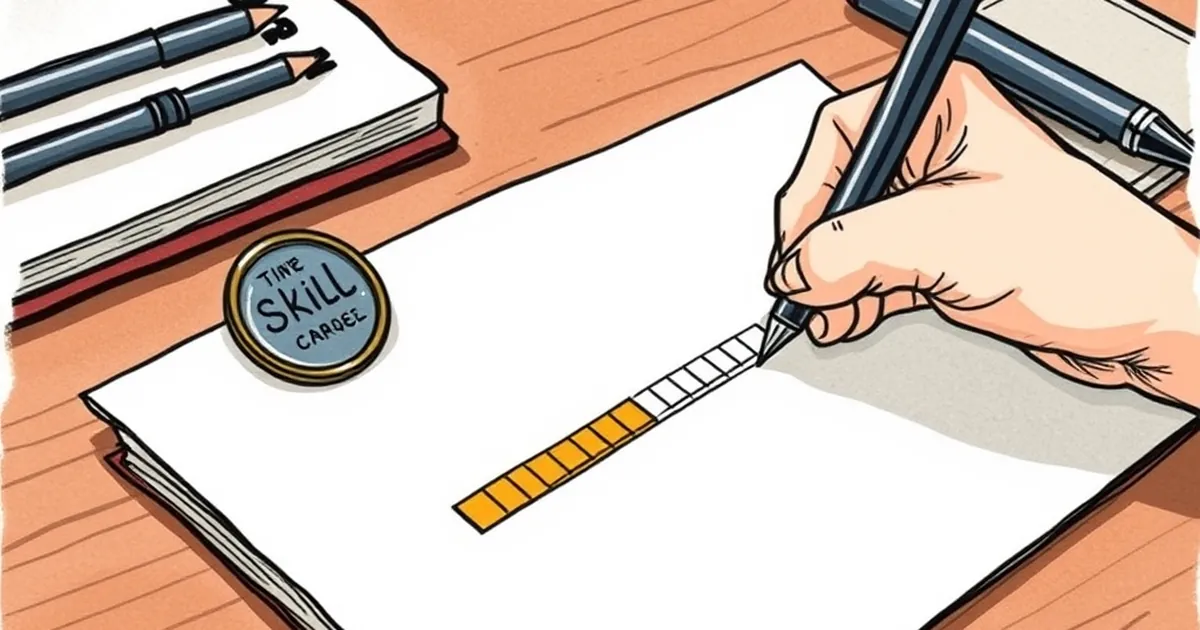
Here's a number that should bother anyone who designs learning products: users hit 80% mastery, earn the skill badge, and 44% of them stop practicing. The badge was supposed to mark progress, not the finish line. So what exactly is the badge telling people, and why does it work against the practice it's meant to encourage?
The Badge Is a Goal, and Goals Have Edges
Behavioral economists have known for decades that people don't evaluate outcomes in absolute terms. Kahneman and Tversky's prospect theory showed we judge gains and losses relative to a reference point, and once we reach that point, the motivation curve bends sharply. A badge at 80% creates a reference point out of thin air. Before the badge, practice is open-ended. After the badge, practice becomes "extra," and extra is the first thing people cut when the reward is already banked.
This is goal-gradient behavior in reverse. Research on loyalty programs (Kivetz, Urminsky, and Zheng, 2006) found that effort accelerates as people approach a reward, then collapses once it's claimed. The 44% figure isn't a mystery. It's the predictable backside of a well-designed finish line.
Variable Rewards Keep People Practicing. Fixed Badges Don't.
The most persistent behaviors are sustained by unpredictable reinforcement, not guaranteed payouts. Skinner's variable-ratio schedules produced the highest and most durable response rates in his experiments, which is why intermittent feedback keeps people engaged far longer than a fixed, one-time prize.
Most skill badges are the opposite of variable: binary, predetermined, and identical for everyone. Earn it once, and there's nothing left to discover. If you want practice to continue past 80%, the reward has to keep moving and keep surprising. Think streaks that reset, mastery levels that reveal themselves only after you engage, or peer comparisons that shift weekly. The point isn't to manipulate. It's to keep the feedback loop alive so the learner keeps finding out something new about their own skill.
Loss Aversion Is Sitting There Unused
Here's the strange part: designers build badges to create gains, when loss aversion is roughly twice as motivating. Losing something hurts more than gaining the same thing feels good, per the same Kahneman and Tversky work. A badge that can decay, dim, or require upkeep flips the psychology. Instead of "I already have it," the user thinks "I don't want to lose it." That single reframe can carry practice past the plateau.
What 80% Actually Means
There's a deeper design question hiding here. Why is 80% the badge threshold at all? In most real skills, 80% mastery is competent but not fluent, and the last 20% is where the actual confidence and transfer live. A badge that celebrates 80% implicitly tells users the remaining 20% doesn't matter. It does. The badge should probably mark a stage, not a summit, with a visible next tier that's close enough to feel reachable.
Where This Goes Next
The forward move for anyone building skill-tracking interfaces is to stop treating badges as endpoints and start treating them as waypoints with momentum. Design the reward to change shape after it's earned: unlock a harder variant, introduce a decay mechanic, or surface a comparison that makes the next 10% feel concrete. Test whether your badge increases practice after the claim, not just before it. If 44% of your users stop at the finish line, the finish line is the problem — and it's one you can redesign.
— creative mess