Skill Tier Badge Upgrades 2s Before the Win Screen Loads
The badge upgrade appearing before the win screen isn't a glitch but a deliberate design choice that reframes rank badges as rewards
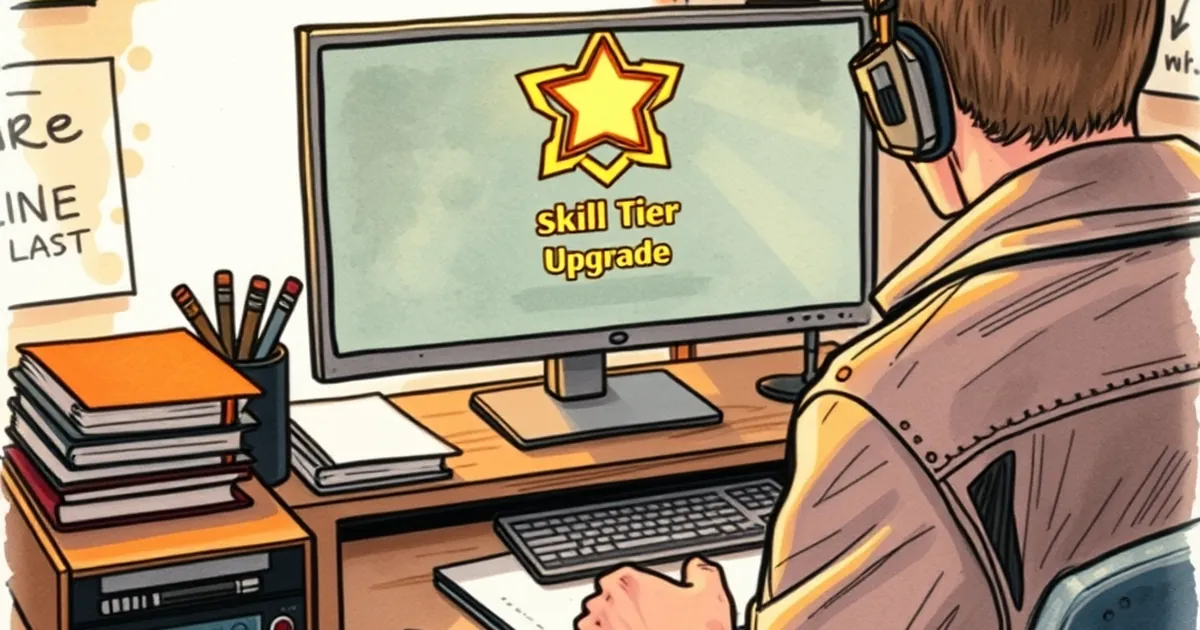
You've probably felt it: you win a match, and for a beat or two the screen sits there, and then the badge upgrades—rank tier, skill division, whatever the game calls it—and only after that does the victory screen appear. It feels backwards. The badge should confirm the win, not announce itself before the win is shown. So why does the interface treat the upgrade as the thing that happens first? That's not a rendering quirk. It's a design decision, and a revealing one.
The badge isn't a receipt, it's a reward
Most people assume rank badges are feedback: you won, so the system tells you what that win was worth. But in practice, badges are the reward, and the win is the setup. Designers know this, which is why the upgrade gets the first beat of the sequence. The win screen is context; the badge is the payoff.
This is a small version of what behavioral economists call variable-ratio reinforcement—the pattern where a reward arrives unpredictably relative to effort. You know roughly when a tier-up is coming, but not exactly, and that uncertainty is what makes the moment land. If the badge upgraded on a fixed, boring schedule, you'd stop noticing it within a week.
Sequencing is a design craft, not an afterthought
Here's where this overlaps hard with web and product design for business. Every interface has a sequence: what the user sees first, second, third. Most teams treat sequencing as polish. It's actually the load-bearing wall.
Think about a checkout flow. You don't show the "Order confirmed" screen before the payment processes. But you do show a spinner, then a checkmark, then the receipt—because the emotional payoff (the checkmark) has to land before the informational payload (the receipt). Games do the same thing with badges and win screens. The badge is the checkmark. The win screen is the receipt.
Kahneman's work on loss aversion explains why the ordering matters so much. Players feel a rank drop roughly twice as sharply as an equivalent climb, which means the badge system is doing emotional work on both ends. The upgrade animation has to feel earned and slightly surprising, or the whole loop collapses into noise.
A concrete case: the "almost there" bar
One of the clearest examples is the progress bar that fills to 98% and then stops, right before the tier-up. Designers call this the near-miss fill. It's not deception—the bar is accurate—but the pause is deliberate. Research on goal-gradient effects (Kivetz, Urminsky, and Zheng's 2006 coffee-card studies are the classic reference) shows people accelerate effort as they approach a reward. A bar that stalls at 98% exploits that acceleration: you're more likely to queue another match when you can see the gap.
The badge-upgrade-before-win-screen is the same principle, just compressed into two seconds. The gap between "you won" and "here's what it was worth" is where anticipation lives.
What this means for business-facing design
If you build dashboards, onboarding flows, or client portals, you're running a badge system whether you call it one or not. The question is whether you've sequenced it deliberately.
A few forward-looking moves worth testing this quarter:
- Put the payoff before the data. When a client hits a milestone, show the celebration, then the numbers. Reversing that order flattens the moment.
- Build one "almost there" state into your product—a visible, honest gap that invites the next action.
- Audit your tier language. If your loyalty tiers or skill levels read like a spreadsheet, they're not doing reward work. Rewrite them as achievements.
- Measure the pause, not just the click. The two seconds after a win are a design surface. Instrument them.
The badge upgrades first because the badge is the point. Design your interfaces like you believe that, and the rest of the sequence tends to sort itself out.
— creative mess