Roulette's House Edge: Where the Green Pockets Do the Work
European roulette's 2.7% house edge comes from a single green pocket, and the math behind why that one number quietly powers the entire game
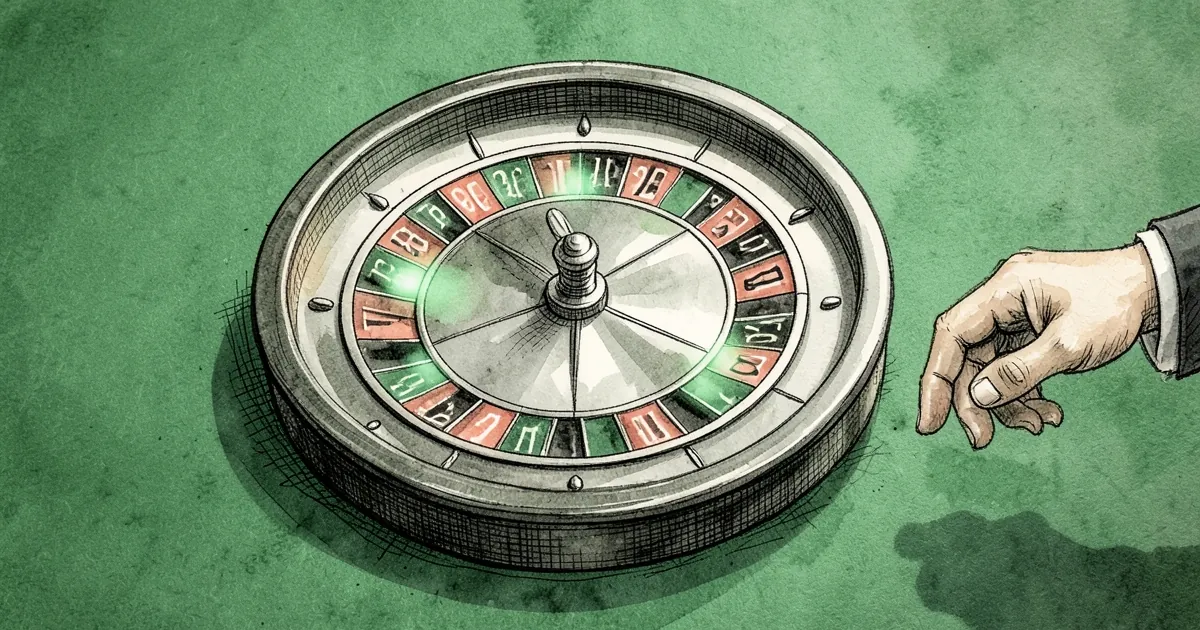
A European roulette wheel has 37 pockets and pays even-money bets as if it had 36. That single missing number is the entire house edge — 2.7% on every bet that isn't a straight-up, and 5.26% on an American wheel with its extra double-zero. The green pockets aren't decoration. They're the product.
The math is boring, which is why it works
On a single-zero wheel, an even-money bet like red or black wins 18 times out of 37. You get paid 1:1, so the expected value per unit staked is (18/37 × 1) − (19/37 × 1) = −1/37, or about −2.70%. A straight-up number pays 35:1 but hits once in 37 spins, giving the same −2.70%. Every standard bet on a European wheel lands on that identical figure. The layout feels varied; the edge doesn't.
American roulette adds the 00. Now 38 pockets, and the number drops to −2/38 = −5.26%. Same game, nearly double the tax. That's the whole argument for checking the wheel type before you sit down.
Where the green pockets actually sit
The zero (and double zero) are the only pockets that lose for both red and black, both odd and even, both high and low. On a spin landing green, every outside bettor at the table loses simultaneously. That's roughly 1 in 37 spins on a single-zero wheel — about 2.7% of the time, which is exactly the edge.
The "la partage" rule, common on French tables, refunds half your even-money stake when zero hits. That cuts the edge in half, to 1.35%. "En prison" works similarly, holding your bet hostage for a spin instead of taking half. If you're choosing between two tables, these rules matter more than the felt colour.
Short sessions hide it, long sessions don't
The edge is a long-run number. Over 100 spins at €10 a spin, expected loss on a European wheel is about €27 — but variance means plenty of players walk away up. The house doesn't need you to lose tonight. It needs volume. This is the same quiet arithmetic that makes a house edge that never sleeps so hard to see spin to spin, and why an RTP meter glowing green before the spin even counts can feel reassuring while telling you almost nothing about your next ten minutes.
Why the wheel isn't the only edge
Physical wheels drift. A wheel with a slight tilt or a worn fret can favor certain sectors, and modern wheels get checked for this — but the check itself becomes part of the story: a biased wheel is a house problem, not a player opportunity. Online, RNG wheels remove the physical bias and leave the pure 2.7%. Either way, the green pocket is the constant.
What you do with 2.7%
The edge is small enough that roulette is a reasonable entertainment spend and large enough that no betting system erases it. Martingale, column covers, "sectors" — all of them just rearrange when you lose, not whether. The honest question isn't how to beat 2.7%; it's whether the €27-per-100-spins figure fits what you're actually there for. If it doesn't, the wheel will tell you eventually — the same way a bonus meter's final pixel tells you the odds shifted after the fact. Set a loss limit before the first spin, and treat the green pocket as the price of admission rather than a bad beat.
— creative mess