When the Slot's Max Bet Button Doubles Your Stake, Not the Lines
Slot max bet buttons multiply your total stake rather than adding paylines, so the reels and paytable stay the same while your bankroll moves faster
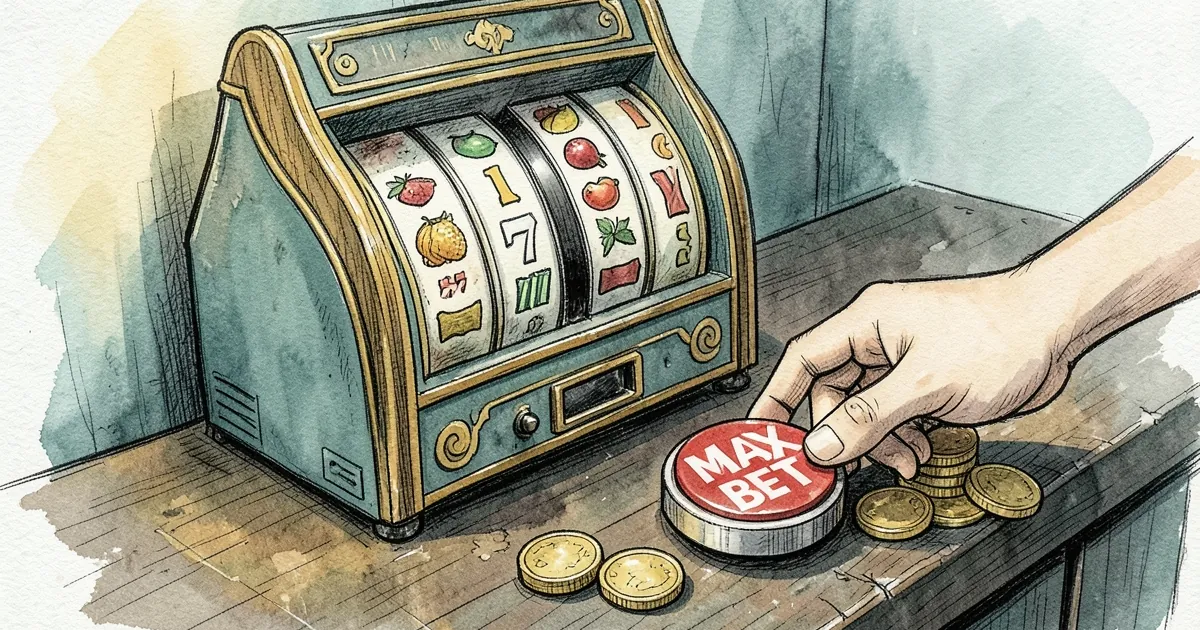
The max bet button on most modern slots doesn't add paylines, ways, or anything else that changes how the game plays. It just multiplies your current total stake by a fixed factor — usually 2x, sometimes 5x or 10x — and leaves the reels, the paytable, and the hit frequency exactly where they were. You're buying the same spin at a higher price, which means the only thing that really changes is how fast your bankroll moves and how much each win is worth in absolute terms.
The button is a multiplier, not a mode switch
On older three-reel machines, "max bet" meant something. You were buying all the coins per line, and on some games the top jackpot only paid at full coin — the classic 3-coin max on a 1-coin game. That legacy stuck around in the interface language even after the mechanics changed. On a 20-line video slot, the bet is already covering every line by default; pressing max bet doesn't unlock a hidden payline, it just scales the stake.
A 2x multiplier sounds harmless until you notice the button sits right next to spin. Fat-finger it twice and you're at 4x. The bet slider that snaps to a stake you can't afford is the same failure in a different costume — the control moves faster than your reading of it.
Where the money actually goes
RTP doesn't shift when you raise the stake on the same game. A slot at 96.1% is 96.1% at €0.20 a spin and at €4.00 a spin. What shifts is variance in cash terms and the speed at which you burn through a session budget. If you're playing 400 spins an hour at €0.50, that's €200 of turnover an hour; double the stake and it's €400, with the house edge taking twice as much in expected value per hour even though the percentage is identical.
That's why payout ratios can look like they moved when you raise the stake — they didn't, your sample just got smaller relative to the money at risk. There's a good breakdown of that illusion in payout ratios flipping 0.2% the second you raise your stake.
A concrete anchor
On a typical 96% slot, doubling the stake from €1 to €2 raises expected hourly loss from roughly €8 to €16 at 400 spins per hour (400 × €1 × 4% versus 400 × €2 × 4%). Same game, same RTP, twice the bleed. Over a three-hour session that's €24 versus €48 in expected cost — real money for a button that changed nothing about the game.
The mobile problem
On desktop, max bet is usually a labelled button you have to aim at. On mobile it's often crammed into the bottom bar next to spin, sometimes with a smaller tap target than the spin button itself. Zoom gestures and thumb drift make mis-taps more likely, and some layouts put max bet exactly where your thumb rests. If you've ever wondered why the stake jumped without you touching a slider, double-tap zoom disarming the max bet button on mobile covers the gesture-layer side of it.
Worth checking before you play: whether the button shows the new total stake before you confirm, or fires the spin immediately. Many games do the latter.
What to do with this
Treat max bet as a stake shortcut, not a feature. If you want a bigger win, you're paying for it in expected loss per hour, not unlocking better odds. Set your stake with the slider or the minus button, then leave it alone — and if a game's max bet button sits within a thumb's width of spin, that's a design choice worth noticing.
The open question is whether operators should be required to show the new total stake on the button itself, not just in a corner display. Some regulators have pushed for clearer bet confirmations on mobile; most haven't touched the max bet button at all. Until they do, the safest read is that the button does exactly one thing: it makes each spin cost more. Keep an eye on your session budget, take breaks, and don't let a mis-tap set your pace for the night.
— creative mess