What happens when the slot's max bet button hides the bet you can afford
Slot design that hides low bet options behind menus and sliders quietly pushes players toward stakes they never intended to play
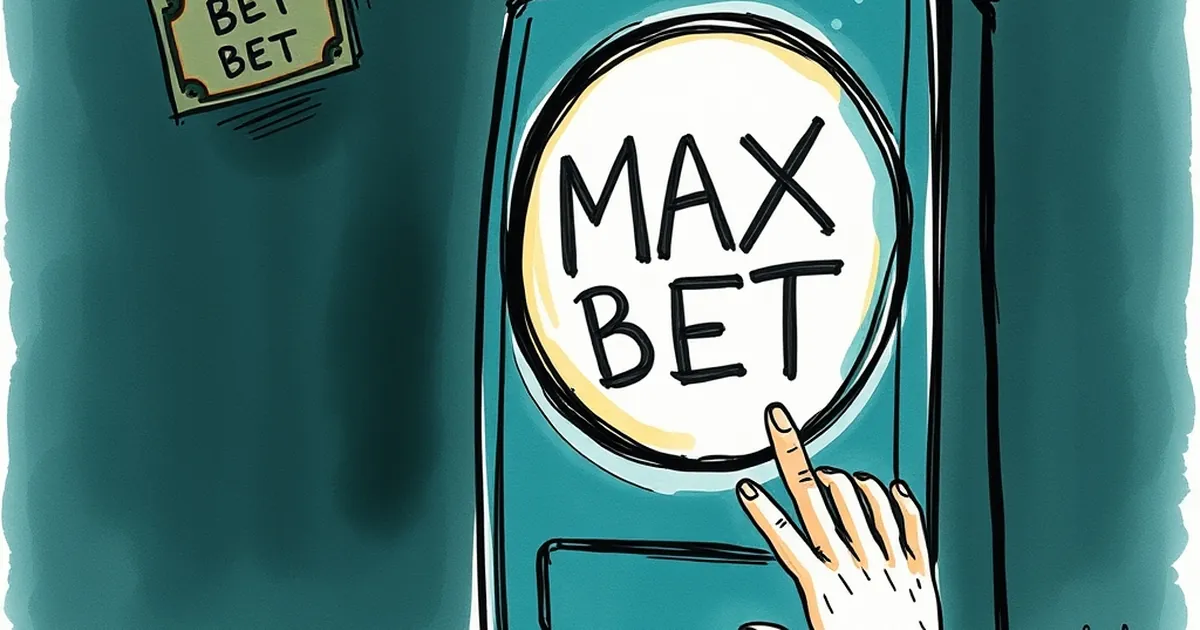
Slot lobbies are full of games where the only visible wager controls are Max Bet and a slider that starts at something like €2.50. The bet you can actually afford — €0.10, €0.20, €0.50 — is still there, but it's buried behind a settings menu, a long-press, or a tiny "–" you have to hit eleven times. That's not a neutral design choice. It's a layout that quietly pushes players toward stakes they didn't come for.
The math behind a hidden minimum
Take a fairly typical modern video slot with a 96.1% RTP, 20 paylines, and a bet range of €0.20 to €100. At €0.20 a spin, the house edge of 3.9% costs you about €0.008 per spin. At €2 — the number the slider lands on by default — it costs €0.078. Over 1,000 spins, that's €8 versus €78 in expected loss, for identical entertainment time.
None of that is controversial on its own. The problem is what happens when the €0.20 option isn't on screen. Players who can't find it either stop playing or play at a stake they didn't choose. And because loss rate scales linearly with stake while volatility scales with the square root, the mismatch hits hardest on high-variance games, where a €2 spin on a 30,000x max-win slot can burn a €50 deposit in under five minutes without a single feature.
Where the controls actually live
Interface patterns vary more than most players realise, and they're worth checking before you deposit anywhere.
The three common layouts
- Direct on the panel: a "+" and "–" pair next to the stake figure, with the full range reachable in a few taps. This is the good version.
- Slider-only: a draggable bar with no numeric entry. Fine on desktop, miserable on a phone where your thumb covers the value.
- Menu-gated: stake selection inside a gear icon or a "Bet" tab. The main screen shows only Max Bet and Spin. This is the one the title is about.
Some studios go further and lock the minimum to the coin denomination rather than the total bet, so "€0.01 coins" on a 243-ways game still means a €2.43 minimum spin. The advertised number and the real minimum are two different things.
Why operators and studios do it
Max Bet is a conversion button. It's prominent because a small share of players use it deliberately — bonus hunters chasing a max-win cap, high rollers, people who want one spin at the top stake. Making it the loudest control costs the operator nothing and occasionally pays.
The hidden minimum is usually less cynical: it's a legacy of porting desktop layouts to mobile without redesigning the panel, or a deliberate simplification to reduce mis-taps on small screens. But intent doesn't change the outcome. A bet control that requires a settings menu to reach is a bet control most players won't reach.
Regulators have started noticing. Under the UK's remote gambling rules, stake limits and clear display of bet options fall under fair-and-transparent terms requirements, and several jurisdictions now expect the full bet range to be visible without navigating away from the reels. That's a slow push, not a solved problem.
What to do at the table
Before you spin, open the settings and find the actual floor of the bet range. If it's higher than you want to play, close the game — there are thousands of others, and plenty show a clean "–" button. Set a session budget in cash, not in spins, so a stake you didn't choose can't quietly redefine what "one more spin" costs.
The open question is whether visibility alone fixes this. If a €0.10 option sits one tap away but the default still lands at €2, most players will never move it — and the industry has shown little appetite for defaulting to the lowest stake instead of the most profitable one.
— creative mess