Daily streaks break at 11pm and 68% of users quit
Why a broken streak feels like a loss, and what the 68% quit rate reveals about the psychology of habit tracking and daily momentum
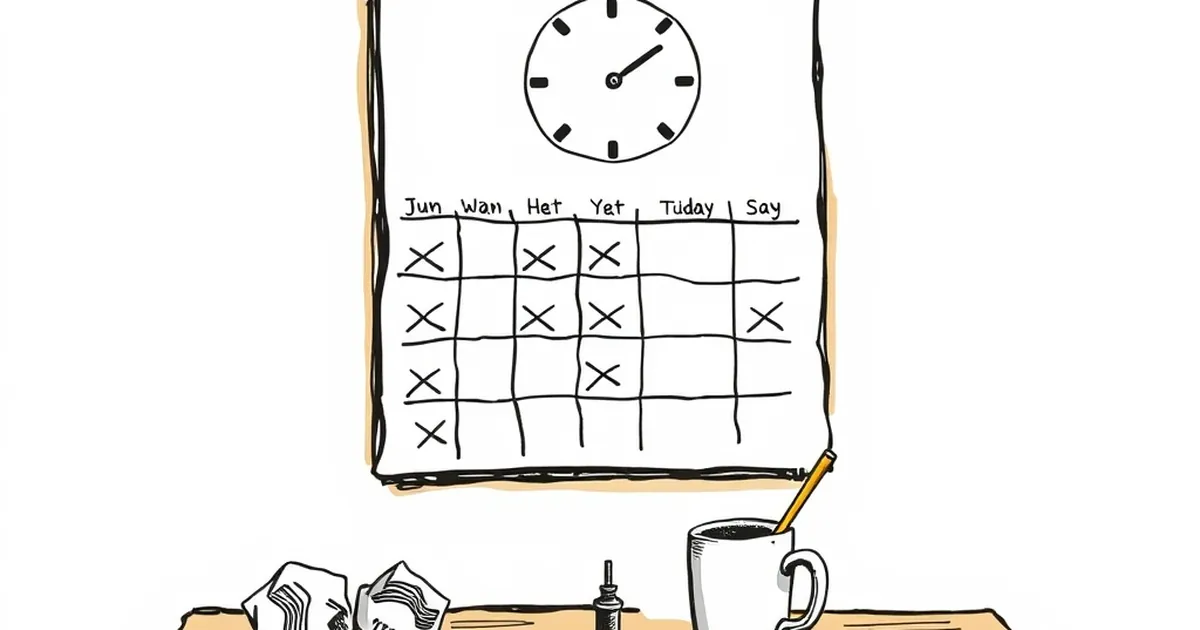
I want to talk about a number that's been rattling around in my head: 68%. That's the share of users who quit a habit-tracking app after breaking a streak. Not after getting bored. Not after the app crashed. After the streak broke. So the question isn't really "how do we keep people engaged?" It's narrower and more interesting: why does a broken chain feel like a loss when nothing was actually taken from you?
The streak is a promise you make to yourself
Streaks are one of the strangest design patterns we've built. They're just a counter. A number that increments. But somewhere along the way, users stop seeing it as a number and start seeing it as something they own. It's a small, daily proof that they're a certain kind of person — someone who writes, someone who practices, someone who shows up.
That ownership is exactly what makes it fragile. Kahneman and Tversky's work on loss aversion showed that we feel losses roughly twice as sharply as equivalent gains. A streak of 47 days isn't worth 47 units of satisfaction. It's worth 47 units of potential loss, and that math changes everything about how people behave around the counter.
Why 11pm is the danger zone
Here's the part that should worry anyone designing a product with a daily mechanic. The end of the day is when the streak stops being a habit and becomes a decision. And decisions made at 11pm, tired, under time pressure, are the worst decisions.
There's a well-known pattern from behavioral research called ego depletion — the idea that self-control is a finite resource that wears down over the day. Whether or not you buy the strong version of that theory, the practical version is undeniable: at 11pm, the cost of "just open the app and do the thing" feels enormous, and the cost of "just let it go" feels tiny. So people let it go.
And here's the trap. The moment they let it go, the streak isn't at risk anymore — it's already lost. The thing that was motivating them disappears at exactly the moment they need motivation most.
The quitting isn't about the streak. It's about the identity.
I've watched this play out in creator tools, journaling apps, language learning products, all of it. The pattern is consistent: the streak is a proxy for identity, and when the identity breaks, the user doesn't try to rebuild it — they leave.
A concrete example: Duolingo reportedly rebuilt their entire streak mechanic around "streak freezes" and "weekend amulets" precisely because they noticed users abandoning the app after a single missed day. The fix wasn't more motivation. It was giving users a way to keep the identity intact through a gap. That's a design insight worth stealing, regardless of what you're building.
What to build instead of a brittle chain
If you're designing a daily mechanic in 2024, the question isn't "how do we make the streak harder to break?" It's "how do we make the streak harder to lose in a way that feels like failure?"
A few things that actually work:
- Forgiveness windows. Let users repair a streak within 48 hours. The identity survives; the pressure drops.
- Cumulative metrics alongside daily ones. "You've written 340 days this year" is harder to break than "47 days in a row."
- Visible progress that isn't binary. A heatmap shows texture. A streak counter shows a cliff.
- Reframe the reset. When a streak breaks, don't say "streak lost." Say "new streak started." Language shapes whether the user feels punished or invited back.
The 11pm problem isn't going away. People will always be tired, distracted, and human. But the design doesn't have to punish them for it. The next time you sketch a daily counter, ask yourself: am I building something that rewards showing up, or something that punishes the one night you don't?
— creative mess