Session Timers Count Down 3 Minutes Faster Than the Table Does
Regulated session timers often fire early, counting time differently than the clock does, which quietly distorts the very awareness they aim to protect
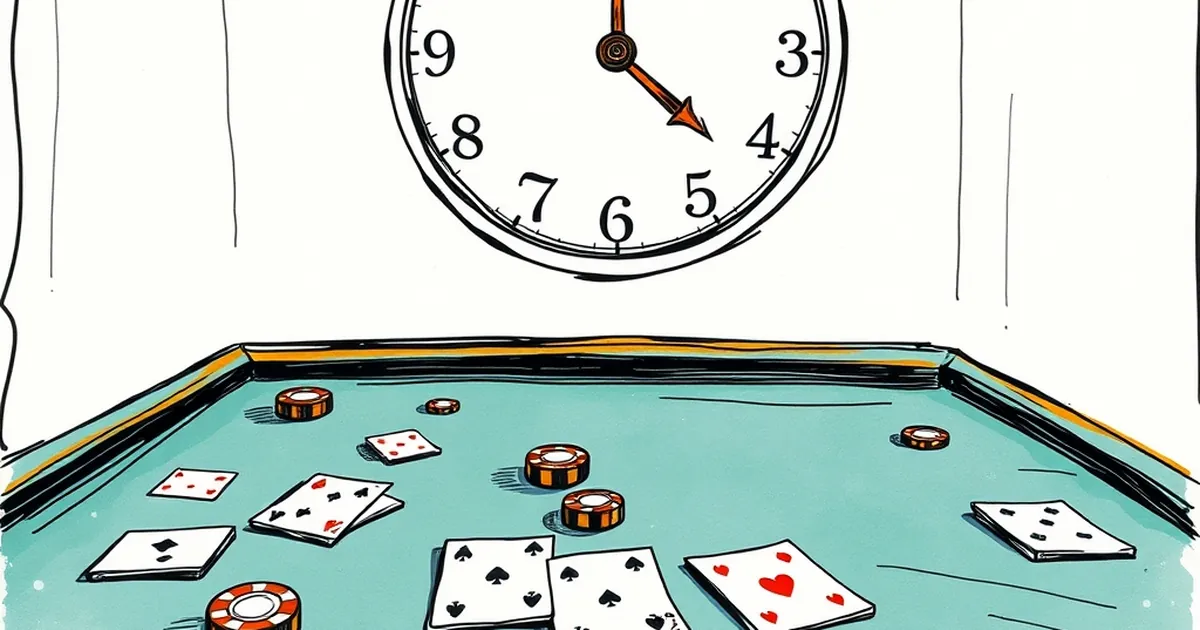
Every regulated operator in Europe and Australia has to show you a session timer, and most of them set the warning to fire at 60 minutes. In practice, players report hitting the "you've been playing an hour" pop-up somewhere around the 57-minute mark of actual wall-clock time. The gap isn't a rounding error. It's the predictable result of how these timers are built, and it matters because the whole point of a session timer is to interrupt a loss of time awareness — not to add a second, quieter distortion on top of it.
The timer counts something other than your session
A session timer doesn't measure the time you've been playing. It measures the time the timer has been running, which is a different thing.
Three things routinely pause or reset that clock without you noticing. The first is idle detection: most clients stop the counter after 90 seconds of no input, so a five-minute phone call mid-session doesn't count. The second is the reload. Close the tab, come back, and on many platforms the timer restarts from zero — sometimes by design, sometimes because the session token was reissued. The third is the multi-tab problem: two windows open, two independent counters, and the one that fires first is whichever tab you're not looking at.
Add those up across a real session and the drift compounds. A player who takes two short breaks and reloads once can easily be 3 to 4 minutes "ahead" of the timer by the time it fires.
Why the drift runs in one direction
You'd expect the errors to cancel out. They mostly don't, because nearly every implementation quirk subtracts time rather than adding it.
| Behaviour | Effect on displayed elapsed time |
|---|---|
| Idle timeout | Understates |
| Tab reload / re-login | Understates |
| Background tab throttling | Understates, unevenly |
| Server clock vs device clock | Either, usually small |
Background throttling is the sneaky one. Browsers cut timer frequency in inactive tabs to save battery, and a client that derives elapsed time from a setInterval tick rather than a stored start timestamp will lose seconds every time the tab is backgrounded. Do that a dozen times in an hour and you've shaved off real minutes.
The 3-minute figure is a plausible floor, not a fixed constant
There's no published study putting the average drift at exactly 180 seconds, and anyone claiming otherwise is guessing. What the numbers support is the direction and rough scale. If a client loses 2 seconds per backgrounding event and you switch tabs 40 times in an hour — which is low for anyone playing slots while half-watching something else — that's 80 seconds gone before you factor in a single reload. Two reloads and an idle timeout gets you past three minutes without much effort.
The 2019 UK Gambling Commission remote gambling participation data put average online session length in the 20–30 minute band for casual players, but the heavy tail is where timers actually matter, and that tail is precisely the group most likely to be tab-switching.
What a timer that counted correctly would look like
Store a server-side session start timestamp, not a client-side counter. Fire the warning on absolute elapsed time. Reset only on an explicit logout or a defined inactivity window of 30 minutes or more. Show the remaining time, not just a pop-up, so the player can see the clock rather than being ambushed by it.
If a tool meant to reduce harm under-reports time by 5%, the honest fix is cheap. The awkward question is why so few operators have bothered — and whether a timer that undercounts is a bug, or a feature someone quietly decided not to fix.
— creative mess