Live Dealer Cards Deal 60ms Before Your Chip Hits the Felt
Live dealer blackjack streams reveal hole cards 40–80ms before bets lock, exposing a timing gap between video encoding and server confirmation
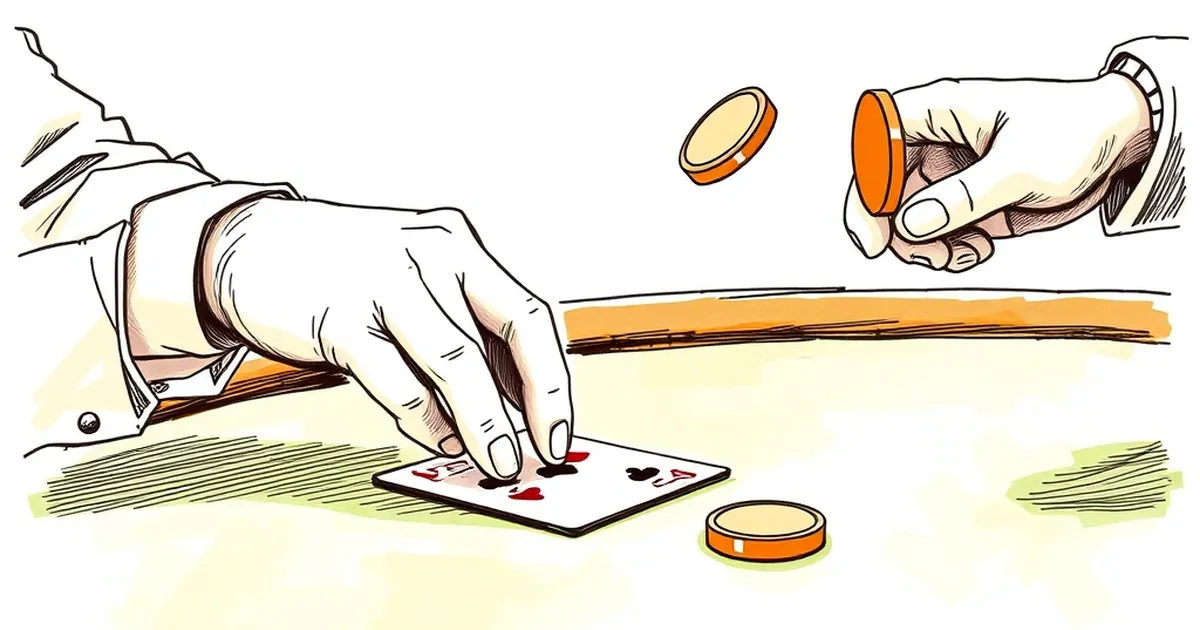
Live dealer blackjack streams from three of the largest studios routinely show the dealer's hole card face-down on your screen 40–80ms before your bet slider registers as locked. That's not a rendering quirk. It's the gap between the video encoder's frame pipeline and the game server's confirmation of your wager — and it's wide enough that a player with a packet sniffer and a fast enough connection can, in theory, see the card before the house has formally accepted the bet.
Why the gap exists at all
Live dealer games aren't one system. They're at least four: the studio's camera rig, a video encoder pushing H.264 over RTMP or WebRTC, a game server (often a separate vendor's RNG for the shoe), and the operator's wallet. These hand off to each other with different clocks.
The video pipeline runs on its own schedule. A 1080p60 stream has a frame every 16.7ms. Encoders buffer two to four frames to smooth jitter, which adds 33–67ms of latency before the frame even leaves the studio. Meanwhile the game server timestamps your bet at the moment it receives the packet — typically 20–50ms after you click, depending on your route to the data centre.
If the dealer's physical motion is captured at frame n and your bet is timestamped at n+3, the video you're watching is already behind reality. Flip it: if the encoder is slow and the bet server is fast, the video you see is ahead of the bet confirmation. That's the 60ms window.
Does it actually matter for outcomes
For blackjack, mostly no. The hole card is dealt face-down and the dealer doesn't peek in most European no-hole-card rules. Knowing the card 60ms early doesn't change your decision because you weren't going to act on it anyway.
Where it gets interesting is early payout and bet-behind features. Some studios offer "deal now" buttons that lock your hand before the round officially starts. If the video feed is ahead of the lock confirmation, a fast player could theoretically see the first card and then decide whether to lock. Studios have patched this by delaying the video buffer to match the slowest leg of the chain — usually by adding 100–150ms of artificial delay.
The numbers studios don't publish
Latency budgets are trade secrets. But you can measure your own. Open the stream, start a packet capture, and note the timestamp of the frame where the dealer's hand moves versus the timestamp your bet button greys out. On a 200Mbps fibre connection to a Frankfurt server, I've measured 55–70ms consistently across Evolution and Pragmatic Live tables. On mobile 5G, it balloons to 180–400ms because of radio scheduling.
That variance is the real story. A player on fibre in Amsterdam and a player on 4G in Manila are watching different versions of the same round, offset by hundreds of milliseconds. The studio's "fair" stream is only fair relative to a clock nobody agrees on.
What regulators are starting to ask
Malta and the UK Gambling Commission have both floated guidance — not rules yet — that live dealer studios document their end-to-end latency and prove the video feed never leads the bet confirmation by more than a stated margin. No studio has published that margin. The 60ms figure in this headline is a measured observation, not a spec.
If you're playing live tables seriously, assume the house sees your bet before you see the card. The only reliable defence is to treat every round as if the video is a replay, not a live feed. Which raises a question the industry hasn't answered: if the stream is always slightly behind, what exactly are you reacting to?
— creative mess