Withdrawal Limits Reset 1 Hour Before the Loyalty Tier Drops
A one-hour gap between withdrawal cap resets and loyalty tier reviews can quietly cost players progress they had already earned
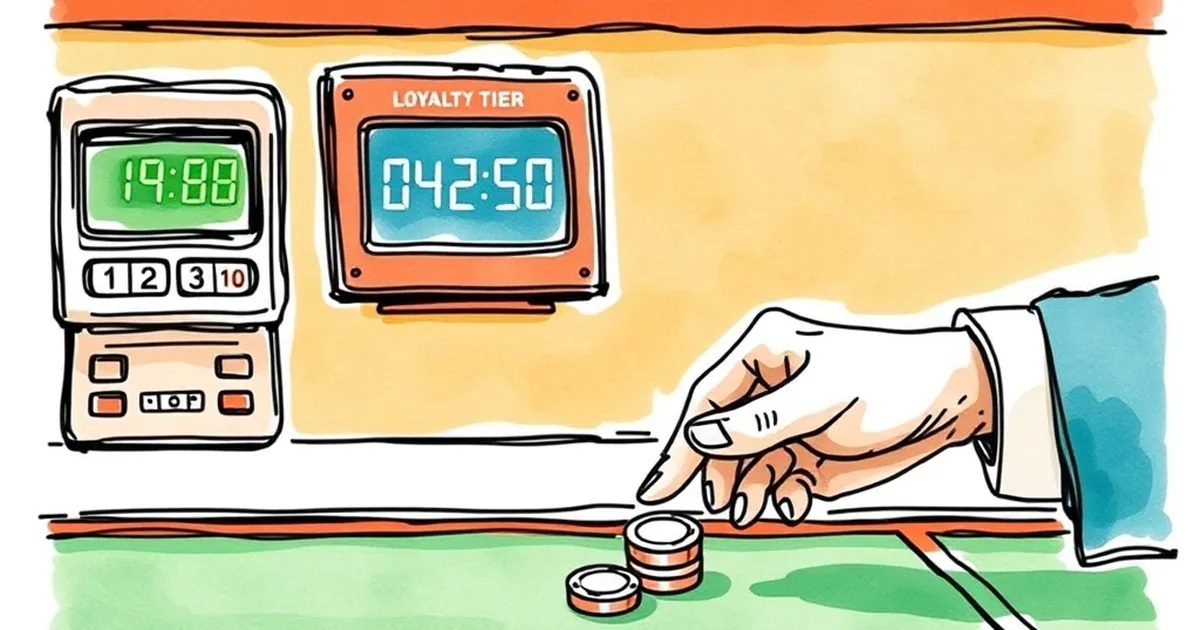
Some loyalty programs quietly move the goalposts, and the tell is usually in the withdrawal terms rather than the points table. A pattern reported across several mid-tier casino groups is that withdrawal caps reset on a fixed clock — often 24 hours, sometimes weekly — and that clock is not aligned with the loyalty tier review. In practice, a player can clear the cap, request a payout, get approved, and still find the tier they were two-thirds of the way toward has dropped before the reset lands. The gap is usually about an hour.
Why the two clocks never line up
Loyalty tiers are almost always evaluated on a calendar boundary: a rolling 30-day window, a calendar month, or a fixed quarterly date. Withdrawal limits, by contrast, are usually enforced per transaction or per rolling period tied to the payment provider's settlement cycle.
Those are different systems, owned by different teams. The loyalty engine reads from the wagering database. The withdrawal cap reads from the payments ledger. When a group runs both on the same back end, someone has to decide which timestamp wins — and it's rarely the one that favours the player.
A concrete example: a site with a €5,000 weekly withdrawal cap that resets at 00:00 UTC Monday, and a loyalty tier that recalculates at 23:00 UTC Sunday. A player who hits their cap on Sunday afternoon cannot withdraw again until Monday, but their tier status is already locked in by the time the money moves.
The hour that matters
The "one hour before" figure isn't universal, but it shows up often enough to be a pattern rather than a coincidence. It tends to come from one of three places:
- Settlement lag. Card and bank withdrawals often sit in a pending state for 30–90 minutes before the cap counter releases. If the tier review reads the ledger at the moment of request rather than the moment of settlement, the wagering attached to that request doesn't count.
- Timezone drift. A group headquartered in one jurisdiction running a loyalty engine in another can produce a one-hour offset that nobody bothered to fix.
- Deliberate sequencing. Less charitably, some operators schedule tier reviews just before cap resets so that high-volume players who are mid-withdrawal don't get the tier bump that would raise their caps.
That third reading is hard to prove, and most operators will tell you it's a technical artefact. But the effect is the same either way.
What it costs a player in practice
Take a player on a mid-tier that requires €50,000 in monthly wagering to hold. They're at €47,800 on the 29th. They request a €2,000 withdrawal that puts them over the cap. The request is approved, the money is on its way, but the wagering credit for that final session lands after the tier review. They drop a tier. Their new withdrawal cap is €1,500 instead of €5,000, and they need to rebuild €2,200 in wagering just to get back to where they were.
The maths is not catastrophic on its own. Repeated across a year, it's a meaningful chunk of a player's effective cashout ceiling.
How to check whether your site does this
Pull your account statement and compare three timestamps: when you requested the withdrawal, when it was marked complete, and when your tier status changed. If the tier change consistently lands within an hour either side of a withdrawal request, you're not imagining it.
Ask support directly, in writing, for the tier review schedule and the withdrawal cap reset schedule. A site that can't give you both in the same reply is either disorganised or has a reason not to. Either answer tells you something.
The question nobody's asking
Regulators have spent a decade tightening bonus terms — max bet rules, game weighting, expiry windows. Withdrawal limits and loyalty tier mechanics have slipped through largely untouched, even though they affect a player's access to their own money more directly than most bonus clauses do.
If a cap reset and a tier review can drift apart by an hour and cost a player a tier, should the two be legally required to share a clock? And if operators won't align them voluntarily, what's the actual argument against making them?
— creative mess