Why Your Tournament Ticker’s Count-Up Makes Late Entries Pointless
Count-up tickers mathematically lock out late tournament entrants before their first spin—here’s why that kills fair play
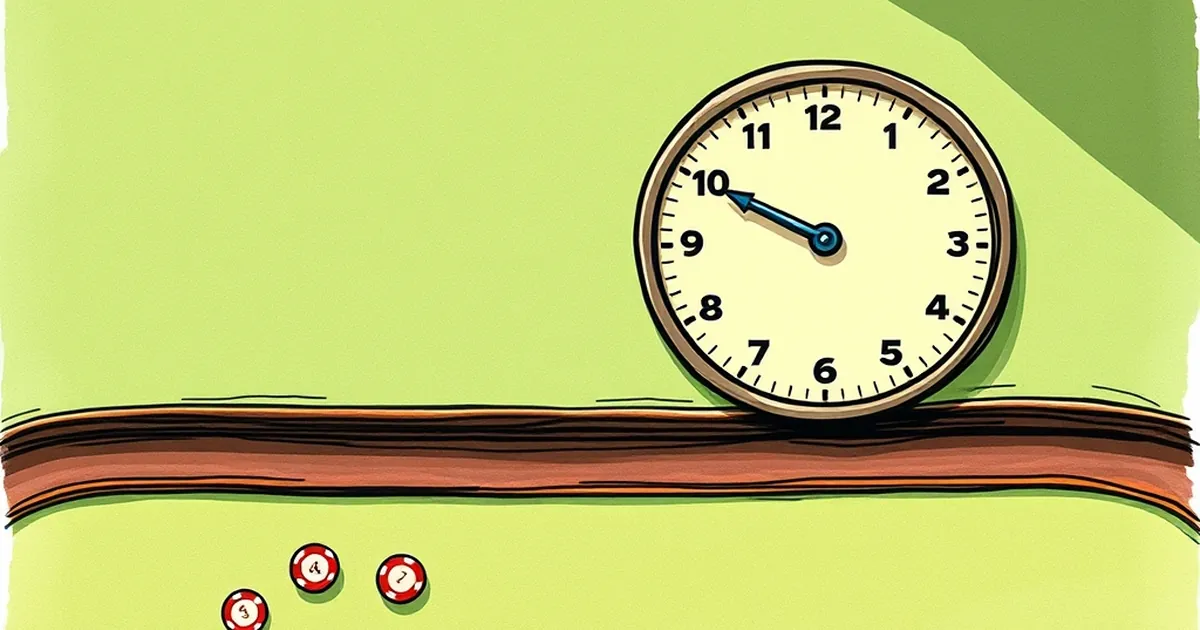
Most tournament tickers count up from zero, and that’s a quiet killer for late registrants. If the leaderboard shows 1,200 points for the top slot and you join an hour in, you’re not just behind—you’re mathematically locked out of the top tier before your first spin. The count-up format hides the real race, which is about time-on-device as much as it is about luck.
The 60-Minute Math Problem
Here’s the ugly stat: in a 24-hour slot tournament with a 100x point multiplier, a player who starts at minute zero and plays steadily for two hours banks roughly 12,000 points. A late joiner at hour 20, even with perfect variance, needs to hit a 1-in-40,000 hand to catch up in the remaining four hours. That’s not a comeback—that’s a lottery ticket with worse odds than the base game.
The count-up ticker makes this worse because it normalizes the gap. You see “3,450” and think “I need 3,450 points.” You don’t. You need to outpace the rate at which the leader is accumulating, and that rate is already compounding.
Why Casinos Keep the Count-Up
They know exactly what they’re doing. A count-up ticker creates a false sense of proximity. “I’m only 4,000 behind” feels beatable, even when the leader is adding 200 points per minute. That emotional pull drives late deposits from players who wouldn’t have entered if they saw the true gap as a percentage. It’s not malicious—it’s just bad UX with a revenue upside.
The Rate-of-Play Blindspot
Most tournament pages show total points but never show points per minute. That’s the only number that matters. If the leader has 15,000 points after 150 minutes, their rate is 100 PPM. A late entrant at hour 20 needs to sustain 125 PPM for four hours just to tie. On a medium-variance slot, that means chasing bonus rounds at max bet, which burns bankroll faster than the leader ever had to.
- Early start advantage: 0-2 hours of play at low risk, building a base
- Late start penalty: 2-4 hours of max-bet chasing, with higher variance and lower survival odds
- The hidden multiplier: some tournaments award extra points for consecutive play streaks, which late joiners can never access
When Count-Up Actually Works
There’s one case where the count-up is fair: leaderboard tournaments with a fixed number of spins per player. If everyone gets exactly 500 spins, the ticker is just a running total of who’s hit the best multipliers. Late entries are irrelevant because the entry window is the same for everyone. But most real-world tournaments don’t cap spins—they cap time, and that’s where the count-up becomes a participation trophy for early birds.
What a Fair Ticker Would Look Like
A countdown from a theoretical max would fix this. Show “Remaining points to catch leader” or “Current leader’s pace: 98 PPM” and let players decide if the chase is worth it. Some poker sites already do this with chips-per-blind metrics, and it kills the illusion. The fact that slot tournaments haven’t adopted it tells you everything about who benefits from the confusion.
The Open Question
If you’re a late entrant and the ticker reads 8,000 points, do you actually have a shot, or are you just funding the prize pool for someone who woke up earlier? The next time you see a count-up, ask yourself: is this a tournament, or is it a head start wearing a leaderboard’s clothes? Because the math doesn’t care how motivated you feel.
— creative mess