Why Your Skill Meter’s Final 5% Feels Like a Fixed Boss Fight
Why your skill meter’s final 5% feels brutal, and how that psychological friction shapes better UX design
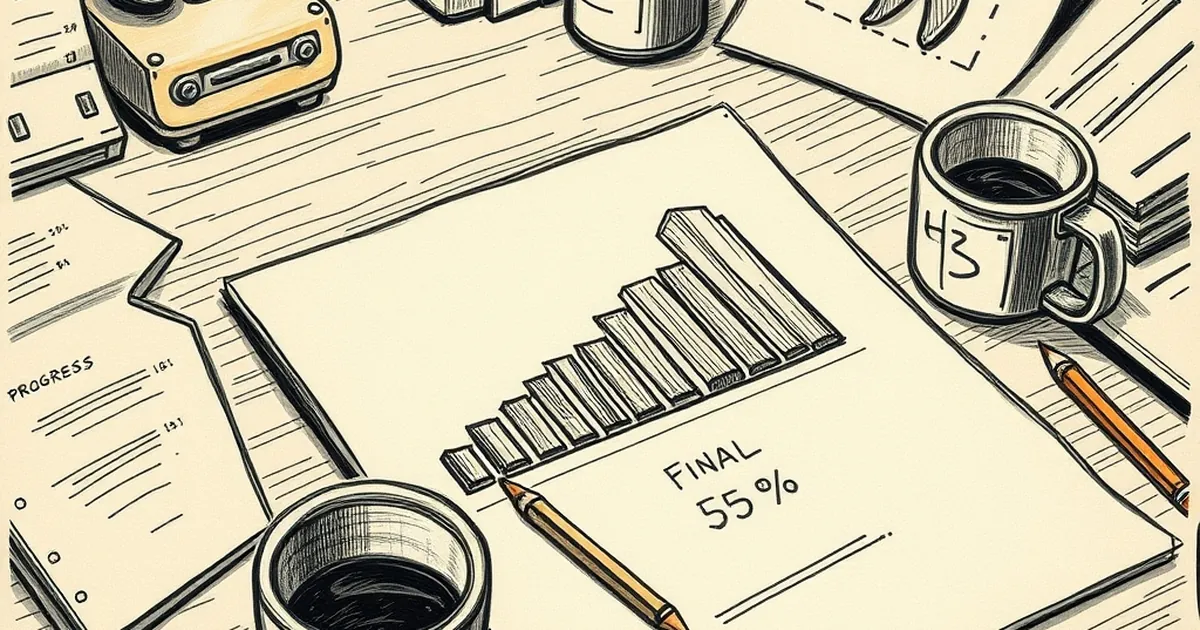
It’s a question every designer has faced while staring at a progress bar, a profile completeness meter, or a skill assessment widget: why does that last stretch from 95% to 100% feel so punishing? It’s not just a UI quirk. That final push taps into something deeply wired in how we process loss, reward, and effort — and understanding it can change how you build for your users.
The Plateau of Perceived Effort
Think about the last time you leveled up in a game. The first 50% of the XP bar flies by. The next 30% slows down. But that final 5% feels like it takes longer than the entire preceding hour. This isn't just your imagination; it’s a classic case of loss aversion, a concept popularized by Daniel Kahneman and Amos Tversky. Once you’re at 95%, you feel you own that progress. Dropping back to 94% (or failing to reach 100%) feels like a loss, not just a neutral state. Your brain magnifies the pain of that potential loss, making the perceived effort of the final steps disproportionately heavy.
Variable Ratio Reinforcement and the “Almost Done” Loop
Here’s where the behavioral overlap gets interesting. In web design, we often use variable-ratio reinforcement — the idea that rewards delivered at unpredictable intervals create the strongest habits. But in a skill meter, we usually apply it backwards. We give constant, predictable feedback for the first 90% (every action adds a clear, steady chunk). Then, we make the last 5% contingent on a rare, unpredictable event: a perfect score, a specific combination of actions, or a subjective review.
This creates a “near-miss” effect. The user experiences a series of almost-successes, which, as research on slot machine psychology (the near-miss effect) shows, actually increases motivation and arousal. But unlike a game of chance, the user knows there’s a skill component. So they keep trying, but the effort-to-reward ratio collapses. The loop becomes: I almost got it, let me try one more time, which is exhausting.
The Fixed Boss Fight: Predictable Punishment
A “fixed boss fight” in a game is one where the challenge is static, not adaptive. Your skill meter does the same thing when the final 5% requires a single, binary action (e.g., “Upload a profile photo” or “Complete the advanced quiz”). There’s no incremental progress within that final stretch. You either do the thing or you don’t. This violates the principle of goal gradient — the psychological phenomenon where people work harder the closer they get to a goal.
The gradient works beautifully from 0% to 95% because each step visibly shrinks the distance. But when the last 5% is a cliff, not a slope, the gradient breaks. The user’s brain says, “I’ve done everything I can, and the remaining hurdle is a binary wall.” The result is frustration, not motivation. It’s the difference between a challenging climb and a sudden pitfall.
One Concrete Fix: The Cascading Sub-Goal
Let’s look at a real-world example: LinkedIn’s profile strength meter. For years, it had a gap between “Intermediate” and “All-Star” that felt huge. Users often stalled because the final push required external validation (endorsements) or rare actions (adding skills that others confirm).
A better model is Duolingo’s streak and XP system, but with a twist. Instead of a binary final step, break the last 5% into a micro-progression of visible, non-binary steps. For instance, if the final point requires a “Perfect Project Brief,” split it into three sub-steps: “Outline,” “Draft,” and “Polish,” each giving 1.6% progress. Now, the user is back on a slope. The loss aversion is still there, but the perceived effort is distributed. You’re converting a fixed boss fight into a series of mini-mobs.
Designing for the “Good Enough” Threshold
The forward-looking takeaway is to stop treating 100% as the only victory condition. In behavioral terms, you want to design for the satisficing point — the moment where the user feels competent and is likely to return. That often sits around 90-95%. If you want to push them to the end, don’t increase the difficulty; increase the clarity and granularity of the remaining steps. Make the final 5% a sequence of tiny wins, not a single, looming gate.
Your skill meter isn’t a test of user willpower; it’s a test of your ability to map a behavioral curve. The next time you see that stuck user at 95%, don’t ask why they’re lazy. Ask why you built a cliff instead of a staircase. Then, rebuild the climb.
— creative mess