Why Your Skill Meter Rewards Persistence Over Actual Mastery
Discover why skill meters reward persistence over mastery—and how to spot the difference between real growth and system exploitation
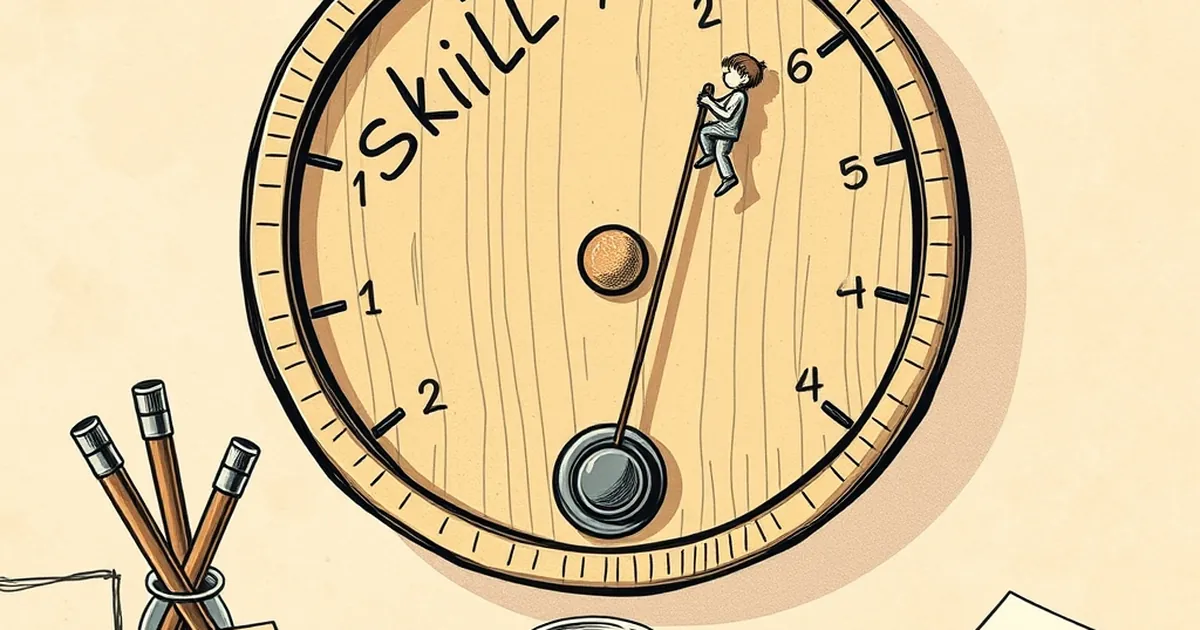
Why Your Skill Meter Rewards Persistence Over Actual Mastery
You’ve been grinding in a competitive game for weeks. Your rank went up. Your “skill rating” looks great. But ask yourself honestly: are you actually getting better, or did you just learn to exploit the system’s reward schedule? This question isn't just for gamers—it’s for anyone building a business website or learning a new craft. The meters we design often measure how long we’ve stayed at the table, not how well we play.
The Dopamine Trap of Variable-Ratio Reinforcement
Behavioral psychologist B.F. Skinner famously discovered that rewards delivered on an unpredictable schedule (variable-ratio reinforcement) produce the most persistent behavior. Slot machines use this. So do skill meters in games like Overwatch or League of Legends—but not for the reason you think.
When you win a match, you get a small rank boost. When you lose, you lose a sliver. Over time, the system creates a “near-miss” effect: you feel you’re one good game away from the next tier. This keeps you playing, even when your actual skill plateaued months ago. The meter rewards your persistence—your willingness to keep queuing—not the micro-adjustments that would make you a better player.
Real-World Example: The Duolingo Streak
Take Duolingo. Its streak feature is a textbook variable-ratio reward system. You practice daily, and the app occasionally gives you bonus XP or a “streak freeze” for logging in. But research from the University of South Carolina found that users who maintained long streaks often did the bare minimum—a single lesson—just to keep the number alive. Their language proficiency didn’t improve significantly compared to non-streak users. The meter rewarded showing up, not learning.
Loss Aversion and the Fear of Falling
Kahneman and Tversky’s prospect theory tells us that losses hurt about twice as much as equivalent gains feel good. Skill meters weaponize this. When you’re one game away from ranking down, the anxiety of losing that status drives you to play more cautiously—or to keep playing far past the point of exhaustion.
On a business website, this manifests as “feature creep.” You add more sections, more animations, more micro-interactions, not because they improve user experience, but because removing anything feels like a loss. The meter (your site’s “completeness” score or your own sense of progress) punishes subtraction. You persist in adding, even when mastery would mean cutting ruthlessly.
The Illusion of Mastery in Competitive Play
In games like Street Fighter or Rocket League, your rank is a noisy signal. A single lucky streak can push you two tiers up. But once you’re there, you face opponents who are genuinely better. You lose repeatedly. The meter drops. You attribute it to bad luck, not skill gaps.
This is the Dunning-Kruger effect in reverse: high-ranked players often overestimate their own ability because the system tells them they’re good, even when their fundamentals are shaky. Persistence got them to the top, but mastery would require deliberate practice—analyzing replays, drilling specific mechanics, seeking honest feedback. The meter doesn’t reward that. It rewards queuing up again.
Redesigning Your Own Feedback Loops
So what do you do if you’re building a skill meter for yourself—or for your users?
First, decouple “time spent” from “improvement.” A dashboard that tracks hours logged is a persistence meter. Instead, track specific, measurable outcomes: number of successful user flows completed, error rate reduction, or concrete project milestones.
Second, introduce deliberate friction. In games, this means limiting ranked play to a few matches per day so you focus on quality, not quantity. For a website, it means scheduling a monthly “audit day” where you remove features that don’t serve core goals—even if it drops your site’s feature count.
Finally, normalize failure as data. A skill meter that penalizes losses encourages safe, repetitive behavior. One that celebrates learning from mistakes—like showing you a heatmap of where users clicked away—turns each loss into a lesson.
The next time you see a rank go up, ask: is this proof of mastery, or just proof that I showed up? The answer might change how you design your next project—and how you play your next game.
— creative mess