Why Your Skill Bar’s Final 10% Feels Like a Luck-Based Tutorial
Discover why the last 10% of learning any skill feels luck-based, and how to push past the brain’s reward switch
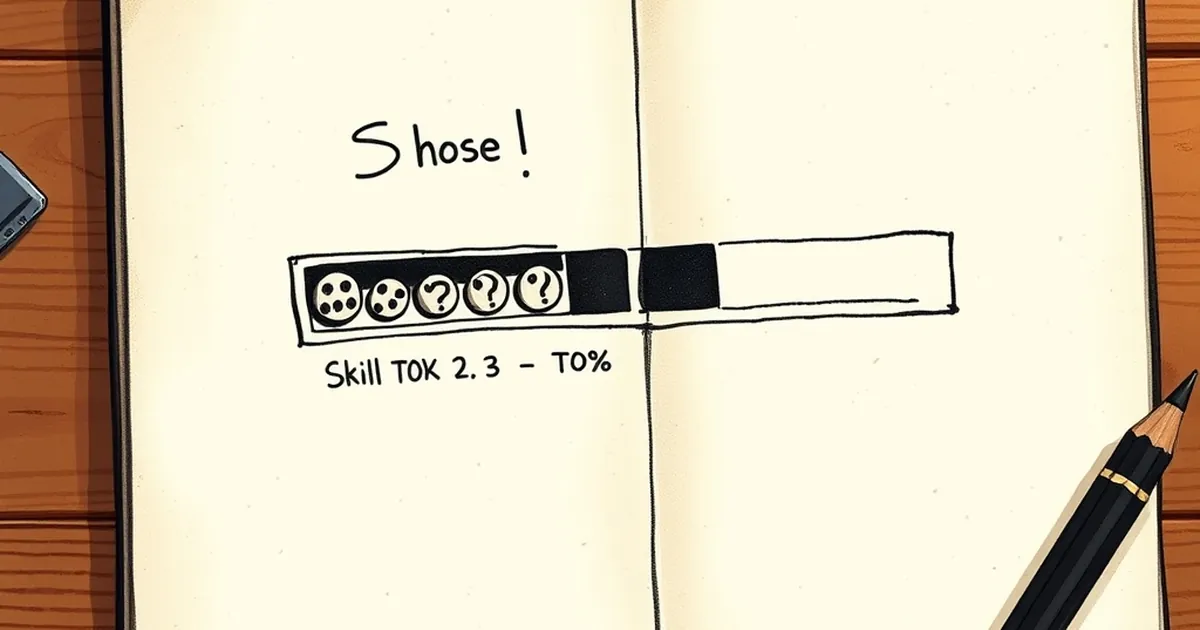
You’re grinding through a new design tool, a coding framework, or even a complex spreadsheet workflow. You feel competent—until you hit that last stretch. Suddenly, your usual logic-driven approach fails, and success feels like it depends on a coin flip. Why does the final 10% of any skill acquisition feel less like mastery and more like a slot machine with extra steps?
The short answer is that your brain isn’t broken. It’s just switching reward systems on you. And understanding that switch is the difference between rage-quitting and shipping that project.
The Variable-Ratio Trap in Your Workflow
In behavioral psychology, B.F. Skinner famously discovered that rats (and later, pigeons) respond most persistently to variable-ratio reinforcement. That’s a fancy way of saying: when rewards come at unpredictable intervals, you keep pulling the lever.
Now, think about your design process. The first 90% of building a website is fixed-ratio. You write a line of CSS, you see the color change. You fix a bug, the layout snaps into place. Every action has a near-guaranteed, immediate payoff. It’s deterministic, and it feels good because you’re in control.
But the final 10%—the polish, the cross-browser quirks, the responsive edge cases—is where rewards become intermittent. You fix one margin issue, and two new overflow problems appear. You tweak a font, and the footer breaks. This is your brain’s version of a variable-ratio schedule. The "win" (a perfectly rendered page) comes at random intervals, which is why you feel addicted to the struggle, yet simultaneously exhausted by it.
Loss Aversion and the Fear of Breaking It
Here’s where Kahneman and Tversky’s loss aversion kicks in. You’ve already invested 10 hours into the project. That sunk cost makes the final 10% feel terrifying because the potential loss of your previous work outweighs the potential gain of finishing.
In competitive play, this is known as "playing not to lose." You stop experimenting with bold layout choices because you’re afraid of undoing the good progress. You become risk-averse, which ironically makes you worse. The result? You stare at a dropdown menu for 20 minutes, paralyzed by the fear that changing one variable will cascade into a visual disaster.
This is why the final stretch feels like luck. You know the solution is there, but your brain is actively suppressing creative risk-taking to protect your ego.
The "Near Miss" Effect in Debugging
Have you ever fixed a bug, only to realize the fix was a typo you accidentally corrected? That’s the near-miss effect—a concept borrowed from studies on competitive play. Researchers found that participants who almost win feel more motivated than those who fail completely.
In web development, the final 10% is a series of near-misses. You get the hero section perfect, then the mobile menu breaks. You fix the mobile menu, then the image compression fails. Each failure is a "near miss" on the overall goal, which triggers a dopamine spike that keeps you going. It feels random, but it’s actually your brain’s way of saying, "You’re close—keep pulling that lever."
The problem? This loop is exhausting. It’s designed for short bursts of survival, not for 3-hour debugging sessions.
A Concrete Example: The CSS Grid Anomaly
Let’s look at a real study from the Nielsen Norman Group on user frustration. They found that users spend 60% of their time on a website’s final polish—not the core functionality. The same applies to creators. I once spent two hours on a grid-template-columns property that worked in Chrome but broke in Safari.
Every fix I tried felt like a gamble. I’d change one value, refresh, and get a completely different result than expected. The breakthrough came when I stopped treating it as a luck-based problem and started treating it as a probability problem. I wrote down three possible solutions, ranked them by likelihood, and tested them systematically.
That’s the key shift: turning variable-ratio chaos into a fixed-ratio experiment.
Practical Close: Design for the "Final 10%" Loop
So how do you beat the feeling of luck? You stop relying on your gut and start building a feedback loop for uncertainty.
- Time-box your experiments. Give yourself 15 minutes to try a fix. If it doesn’t work, move to the next variable. This mimics a fixed-ratio schedule—you’re guaranteed a "stop" even if you don’t get a "win."
- Document your near-misses. When you almost fix something, write down what you tried. This turns random noise into a dataset. You’ll start seeing patterns in your own risk-taking.
- Embrace the "loss" mindset. Accept that you might break a working feature. Once you’re okay with that, the final 10% becomes a sandbox, not a minefield.
The final 10% feels like luck because your brain is trying to protect you from failure. But in reality, it’s the only part of the process where you have true creative freedom. The first 90% is just following rules. The last 10% is where you decide which rules to break. Go break some.
— creative mess