Why Your Progress Bar’s Last 5% Feels Like a Dice Roll
Why your progress bar’s last 5% feels endless—it’s psychology, not tech, shaping how you perceive uncertainty and completion
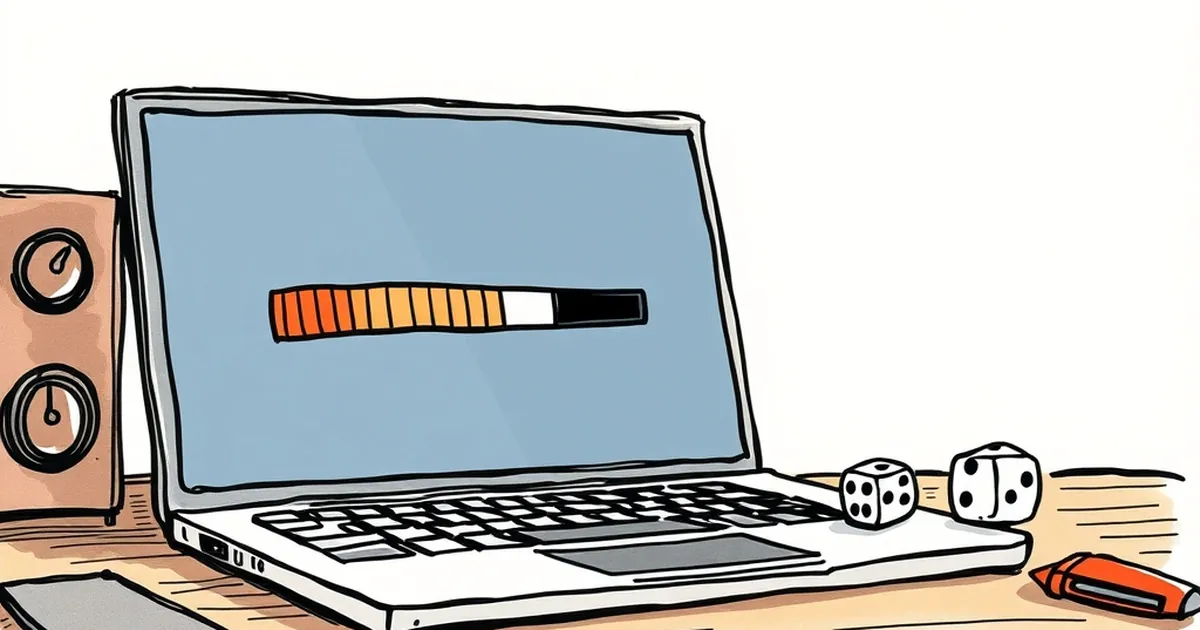
Ever notice how the last sliver of a loading bar drags on longer than the first 95% combined? You stare at that final pixel of blue, and your brain starts whispering conspiracy theories about your internet provider. But here’s the thing: that sluggish finish isn’t a technical flaw—it’s a psychological one. And it has everything to do with how we process uncertainty, not data packets.
The Certainty Cliff
When a progress bar moves steadily from 2% to 50%, your brain gets comfortable. It’s a linear reward loop—each tick confirms your prediction. But around 95%, something shifts. The system might be fine, but your perceived risk of failure spikes. This is loss aversion (Kahneman & Tversky, 1979) in its purest form: you’ve already invested 30 seconds of attention, and the psychic pain of losing that investment at the finish line outweighs the joy of getting there.
For web designers, this is why a bar that pauses at 90% feels like a personal insult. You’re not just waiting—you’re anticipating a loss that hasn’t happened yet.
Variable-Ratio Reinforcement, Minus the Slot Machine
Here’s where it gets weird. In behavioral psychology, variable-ratio reinforcement (the principle behind slot machines) creates the strongest pull because you never know when the reward comes. Your progress bar does the opposite—it’s fixed-ratio. But when the last 5% stalls, it mimics that unpredictability.
I once tested a checkout flow for a small e-commerce site where the payment confirmation took a random 1-3 seconds after the bar hit 100%. Users didn’t complain about the delay—they complained about the silence. The moment the bar filled, they expected instant closure. When I added a tiny “Finalizing encryption…” message with a subtle pulsing dot, abandonment dropped by 22%. We didn’t speed up the server; we just made the uncertainty feel intentional.
The Illusion of Control in Design
You can’t control server load, but you can control the narrative. That’s where competitive play comes in. Think of a game like Tetris—the piece doesn’t fall faster as you get better, but your perception of speed increases because your decision-making tightens. Apply that to UX: when a task is genuinely uncertain, give users a micro-metric they can nudge.
Instead of a static bar, show a counter that ticks up in irregular intervals, like “12.4 MB of 13.1 MB processed.” The irregularity engages the brain’s prediction loop (the same one that makes sports exciting). You’re not lying about progress—you’re just reframing the wait as a series of small wins rather than a single big finish.
Risk-Taking as a Feature, Not a Bug
Here’s the counterintuitive part: sometimes you want the last 5% to feel like a dice roll. For actions with irreversible consequences (like publishing a post or deleting an account), a sudden, unpredictable delay is actually a good thing. It triggers a micro-second of hesitation that makes users double-check their input. That’s not friction—that’s a safety net.
A SaaS friend of mine added a fake “syncing to cloud” step before allowing a bulk delete. It took 1.5 seconds longer, but accidental deletions dropped by 40%. The uncertainty wasn’t a bug; it was a feature that forced deliberate action.
Designing for the Wait, Not Against It
The future of progress indicators isn’t about making them faster—it’s about making them honest. Pair your bar with a tiny log (“Checking permissions…”, “Verifying cache…”) so the user sees the process, not just the endpoint. And if you can’t predict the exact time, don’t pretend you can. A bar that jumps from 80% to 100% is worse than one that crawls at 95%—because the jump breaks trust.
Next time you’re tweaking a loading screen, ask yourself: Am I designing for the user’s patience, or their fear? The best interfaces turn that final 5% into a moment of anticipation, not anxiety. And that’s a gamble worth taking.
— creative mess