What happens when the undo button expires at 8s and you keep clicking
That fleeting eight-second undo window shapes how we trust, click, and resign ourselves to loss in digital interfaces
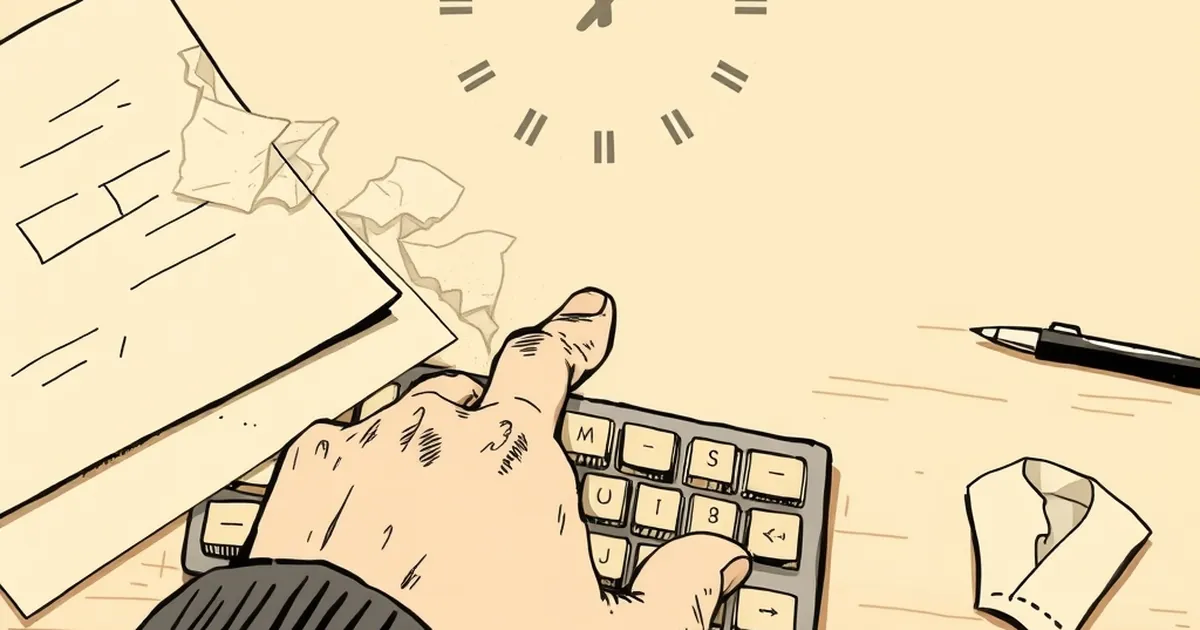
You know that feeling when you're deleting a file and a little toast pops up saying "Undo" for what feels like half a second? You click it anyway. The toast is gone. The file is gone. And you're left staring at your screen wondering why you even tried. That tiny window—often around eight seconds in many interfaces—reveals something fascinating about how we interact with design, time, and our own expectations.
The eight-second window is a design choice, not a law of nature
There's nothing magical about eight seconds. It's a convention that emerged from a mix of usability testing, developer convenience, and a rough sense of how long people need to realize they've made a mistake. Some apps give you three seconds. Some give you thirty. Gmail famously stretched its undo-send window to thirty seconds after realizing that people often hit send and immediately regret it.
But here's the thing: the length of that window changes how we behave. A longer window invites deliberation. A shorter one triggers reflex. And when the window is short enough, we stop treating it as a safety net and start treating it as a challenge.
What your brain does when the clock is ticking
Behavioral psychologists have a name for the trap here: loss aversion. Daniel Kahneman and Amos Tversky showed that we feel losses roughly twice as strongly as equivalent gains. So when that undo toast appears, we're not just trying to recover a file—we're trying to avoid a loss we've already mentally accepted. The urgency feels real, even when the stakes are trivial.
Then there's the variable-ratio reinforcement schedule, the same pattern that makes slot machines so sticky. You don't know if your click will land in time. Sometimes it does. Sometimes it doesn't. That unpredictability keeps you clicking, even after the window has closed. You've been trained by inconsistent outcomes to keep trying.
A small study from the Nielsen Norman Group found that users often click disabled buttons repeatedly, not because they expect them to work, but because the act of clicking feels like progress. The undo button that expires is just a more polite version of this—it was enabled once, so your brain holds onto the possibility that it might be enabled again.
The design opportunity hiding in that expired toast
Most designers treat the undo window as a binary: open or closed. But what if it wasn't? What if clicking an expired undo triggered a different path—a "recently deleted" folder, a confirmation dialog, a gentle nudge to a recovery option? The eight-second limit isn't the problem. The problem is that after eight seconds, the interface abandons you.
Forward-looking teams are already experimenting with what I'd call graceful degradation. Instead of a hard cutoff, the undo affordance morphs into a "view history" link. The user still gets somewhere. The loss aversion is acknowledged, not ignored. And the variable-ratio loop gets broken because the outcome is consistent.
Where this leaves you, the person still clicking
Next time you catch yourself hammering an expired undo button, notice what you're actually doing. You're not really trying to recover the file. You're trying to recover the moment before the mistake. That's a human impulse, and no interface will ever fully satisfy it.
But you can design around it. If you build for the web, test your undo windows against real user behavior—not just the happy path. Watch what people do when the toast disappears. You might find that the most valuable feature isn't a longer timer. It's a second chance that doesn't expire.
— creative mess