Undo buttons time out 8 seconds before users stop trusting the form
The eight-second undo timer is a trust contract with users, and mistiming it quietly erodes their confidence in the entire form
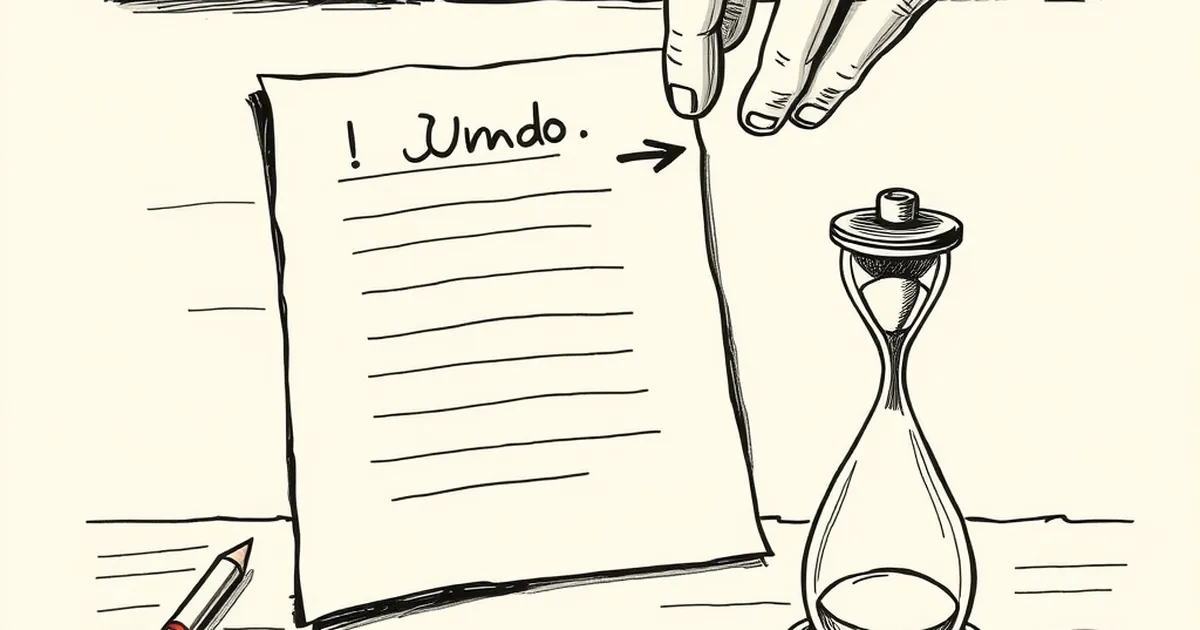
Every designer I know has, at some point, watched a user hover over the undo button like it owes them money. The toast pops up, the eight-second timer starts ticking, and you can almost see the mental arithmetic happening: do I trust this thing, or do I re-type the whole address from scratch? That gap — between having the option to undo and actually believing the undo will work — is where the interesting stuff lives.
The timer is a trust contract, not a convenience feature
When we slap a countdown on an undo toast, we're making a claim about our system: for the next eight seconds, we remember what you did, and we can reverse it. That's a promise with a deadline. And users, consciously or not, are running a risk calculation against it.
Behavioral economists have a name for how badly we handle this kind of calculation. Kahneman and Tversky's work on loss aversion showed that losses feel roughly twice as painful as equivalent gains feel good. Re-typing a form is a small loss. Clicking undo and having it fail is a bigger one — because now you've lost the original work and the time you spent trusting the button. So users don't just weigh "undo vs. retype." They weigh "undo vs. retype, adjusted for the possibility that undo is lying to me."
That adjustment is brutal. A single failed undo, ever, recalibrates the user's model of your entire product.
Variable-ratio reinforcement is not your friend here
Here's where it gets weird. If undo works 100% of the time within the window, users learn to trust it and stop rushing. If it works 80% of the time — say, because of a race condition on slow connections — you've accidentally built a variable-ratio reinforcement schedule, the same pattern that makes people pull levers in Skinner's experiments. Except you're not training them to engage more. You're training them to hover, hesitate, and eventually ignore the toast entirely because the expected value of clicking it has gone negative.
I've seen this in the wild. A checkout flow I audited had a 12-second undo window on address entry, but the undo endpoint timed out at 10 seconds on mobile networks. Users on WiFi trusted it. Users on cellular learned within two sessions to just retype. Same product, two completely different trust relationships, split cleanly along network conditions.
Eight seconds is an arbitrary number, and that's fine
There's no magic in eight. What matters is whether the window matches the user's actual recovery cost. For a one-field edit, three seconds is generous. For a multi-step form submission, eight seconds might be insultingly short — the user is still reading the confirmation screen when the timer expires.
The fix isn't a longer timer. It's decoupling undo from a countdown entirely. Persistent undo (a small "revert" link that lives on the record for a day) removes the deadline pressure and, counterintuitively, gets used less — because users stop panic-clicking and start making deliberate choices.
What to build next
Stop treating undo as a toast. Treat it as a state. If the action is reversible, the reversal should be available for as long as the action matters — not for as long as the animation is cute. Instrument your undo clicks against undo failures. If the ratio isn't effectively 1:1, you don't have an undo button. You have a coin flip with a nice font.
— creative mess