Tip Screens Blur the Second You Hit 20% of Your Bankroll
The 20% bankroll mark triggers a mental shift that clouds judgment, and understanding why can keep your session decisions sharper
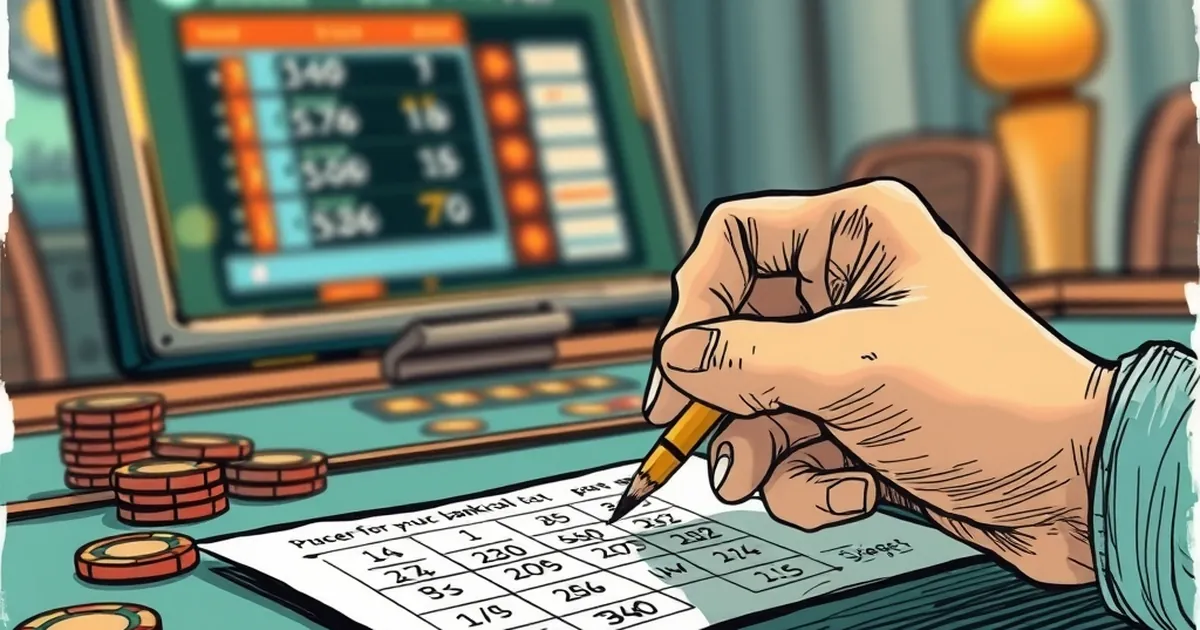
There's a reason the tip screen on a slot or a video poker machine gets harder to read once your balance drops below a fifth of where you started. It isn't the screen. It's you. The 20% mark is roughly where a session flips from "I'm playing with house money" to "I'm playing with my money," and the decisions that follow tend to get worse, not better.
The math behind the fog
Most players don't track bankroll in absolute terms. They track it relative to a peak. If you sit down with $500 and run it to $700, then slide back to $500, that feels like breaking even. Slide to $400 and something else kicks in — you're now 20% below your starting point, and the mental accounting changes.
Behavioural research on loss aversion puts the pain of a loss at roughly 2 to 2.5 times the pleasure of an equivalent gain. That ratio doesn't stay constant as the numbers shrink. A $100 loss from a $500 bankroll stings more than a $100 loss from a $2,000 bankroll, even though the dollar amount is identical. The percentage is what your brain is actually processing.
This is why a $20 spin feels fine at a $1,000 balance and reckless at $200. The bet hasn't changed. The denominator has.
Why "tip screens" are the wrong place to make decisions
Tip screens — the prompts that ask whether you want to add a tip to a bet slip, a slot session, or a dealer hand — are designed for speed. They assume you've already decided. They're not built for deliberation.
By the time you're at 20% of your starting bankroll, you're usually making three or four decisions a minute under time pressure, and the tip screen is just one more. That's the worst possible environment for a rational call about whether to keep going.
A few things that actually help:
- Set the floor before you sit down. Not "I'll stop when it feels bad." A number. $200 left on a $500 start means you're done, and you write it down.
- Decouple the tip screen from the bet. If a platform lets you disable tip prompts, do it. If it doesn't, treat every prompt as a reminder to check your balance, not to act.
- Stop measuring against the peak. Your bankroll is what's in front of you, not what it was 40 minutes ago.
The 20% threshold isn't universal
Different game types hit the wall at different points. A low-variance slot session might grind down slowly enough that 20% feels like a long afternoon. A high-variance video poker run can drop 20% in under 50 hands.
Blackjack players using basic strategy face a house edge around 0.5%, which means a $500 bankroll at $10 a hand has a reasonable shot at lasting several hours. The same $500 at $50 a hand is a completely different session, and the 20% mark arrives fast enough that you might not notice it until you're already past it.
Sports bettors have a version of this too. A 3-leg parlay at +600 pays well when it hits, but the bankroll curve after three losses in a row looks nothing like the curve after three straight singles. The 20% line arrives in the same place regardless.
What the platforms know
Operators have data on exactly when players quit, top up, or chase. They know the 20% mark matters. Some have built features around it — deposit limits, session timers, reality checks that fire at set intervals. Others haven't, because a player who stops at 20% down is a player who isn't generating revenue.
That's not a conspiracy. It's just how the incentives line up.
The open question is whether players can be trained to treat the 20% mark as a hard stop rather than a soft signal. Some do. Most don't. And the tip screen, sitting right there in the middle of the action, isn't going to remind you.
— creative mess