Slot RTP Labels Round 0.4% and 19% Read the Wrong One
Slot RTP labels can be off by 0.4% to 19% depending on which figure you read, and most players trust the wrong one when judging a game
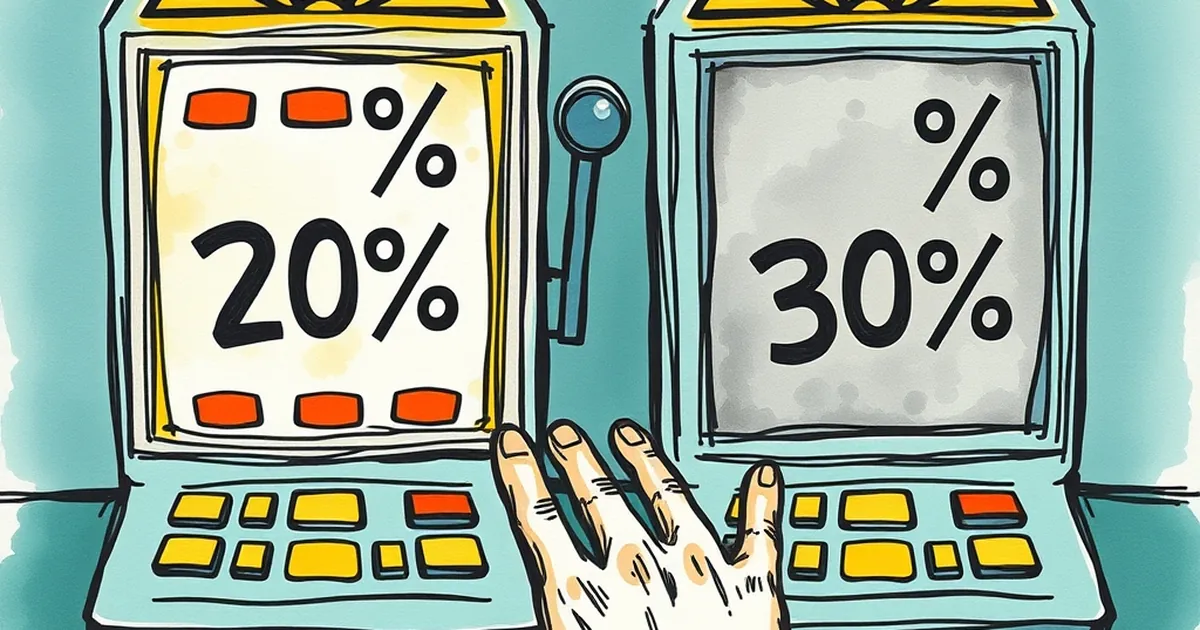
Slot RTP labels on a lot of games are off by 0.4% to 19% depending on which number you actually read, and most players grab the wrong one. The figure in the help screen and the figure on the provider's spec sheet are frequently not the same number, and the gap runs from a rounding shrug to a swing big enough to change whether a game is worth your bankroll. Here's the part that matters: the label you're trusting is often the theoretical one, not the one that applies to the version sitting in front of you.
Two RTPs, One Game
A slot's published RTP usually describes the base game math at default settings. That's a clean number computed over millions of simulated spins. But many titles ship with configurable options — a bonus buy, a "turbo" or "ante" mode, adjustable bet levels that unlock different reel sets — and each configuration carries its own RTP.
The headline 96.2% might apply to standard play. Switch on the feature that lets you buy straight into free spins and the effective return can drop to something like 95.8%, or in some cases climb to 97.1%. Neither is wrong. They're just answering different questions, and the label rarely tells you which one it's answering.
The rounding trap
The 0.4% end of the range is usually benign: one source rounds 96.24% to 96.2%, another truncates to 96.0%. Over enough spins those are the same game. But players compare across titles using these labels, and a 0.4% edge compounds. On a 96.0% game versus a 96.4% game at 500 spins an hour, that's real money drifting out the door — small per hour, stubborn over a year.
The 19% end
The 19% gap is the dangerous one. It shows up when a game has a low-RTP variant — some jurisdictions and some operator configurations run the same slot at, say, 92% instead of 96% — or when the label quotes the max-bet RTP while you're playing a lower denomination with worse odds. A 4-point RTP difference sounds abstract until you do the math: at 92% versus 96%, the house edge goes from 8% to 4%, which means the low-RTP version eats your balance twice as fast per spin. Over a session that's not a footnote, it's the whole story.
Where the Number Lives
Check three places before you commit:
- The in-game help or paytable. This is the version-specific figure. If it disagrees with the marketing page, trust the paytable.
- The provider's spec sheet. Useful for comparing base math, useless for the configured version you're about to play.
- The operator's game info panel. Sometimes the only place a jurisdiction-specific RTP is disclosed.
If those three disagree by more than a rounding hair, assume the lowest number applies until proven otherwise.
Why the Labels Drift
Regulators in most markets require RTP disclosure, but they don't always mandate which configuration the disclosed figure describes. Providers update math without changing the game's name or art. Operators swap in regional variants. The label gets copied forward from an old spec sheet and nobody re-checks it. The result is a disclosure system that's technically honest and practically confusing — a number that's true somewhere, presented as if it's true everywhere.
That's not a scandal. It's just a labeling problem, and labeling problems get solved by reading carefully rather than by trusting the biggest font on the page.
The open question is whether regulators will force per-configuration RTP disclosure on the game screen itself, or keep letting a single headline number stand in for half a dozen real ones. Until they do, the 0.4% and 19% gaps are yours to catch — and the paytable, not the banner, is where you catch them. Play within limits you set before you spin, and treat every RTP label as a claim to verify rather than a promise.
— creative mess