Skill Rating Ticks Up 1 Point Before the Match Ends
A one-point skill tick on hover feels like progress, but it may be noise shaping how clients judge your work and trust your portfolio
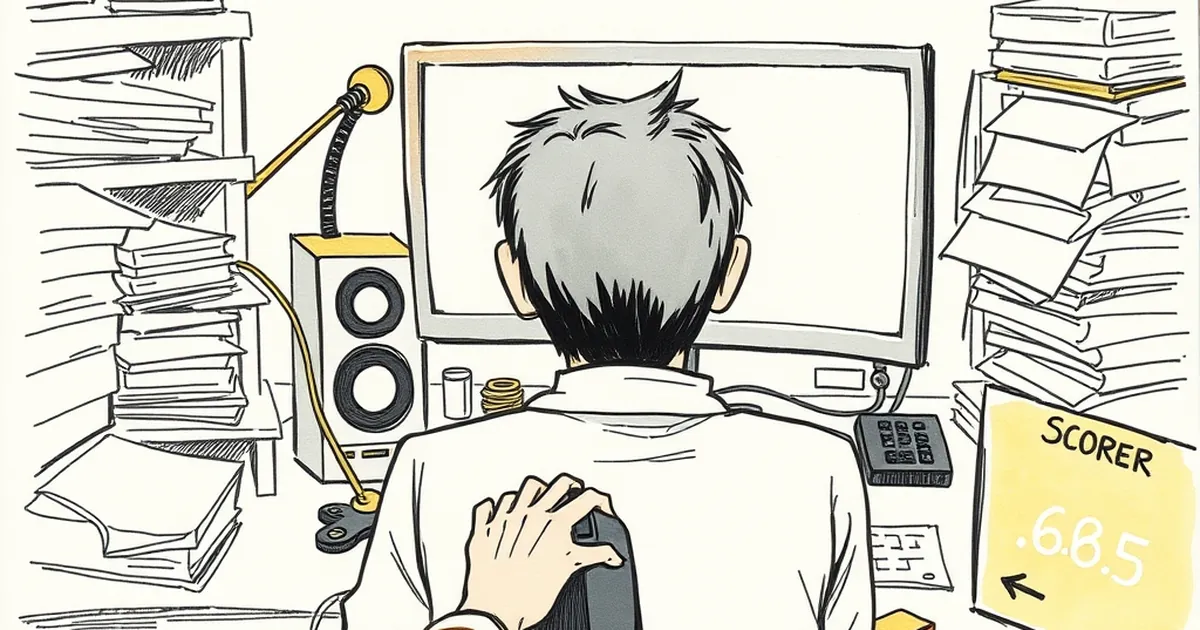
Your design portfolio site has a skill rating widget. It ticks up one point the moment a visitor hovers over a case study thumbnail — before they've read a word. Is that a signal, or just noise dressed up as progress? The question matters more than it sounds, because the same instinct that makes that little counter feel satisfying is the instinct that shapes how clients decide whether to trust you.
Small feedback loops are cheap, and that's the problem
A one-point tick costs almost nothing to render. That's exactly why it spreads. When something is cheap to show and pleasant to see, it gets bolted onto interfaces long before anyone asks whether it means anything.
Behavioral psychology has a name for the pull here: variable-ratio reinforcement. B.F. Skinner found that unpredictable rewards — sometimes a point, sometimes nothing — produce more persistent engagement than predictable ones. A counter that moves at odd intervals feels alive. A counter that moves on a fixed schedule feels like a metronome, and people stop watching.
The trouble is that "feels alive" and "tells the truth" are different design goals. You can hit the first without touching the second.
What a rating should actually represent
If a number changes, a user will build a mental model of what drives it. That model is your real product. Get it wrong and you've taught someone a false lesson about their own progress.
Concretely: if your widget bumps a point on hover, visitors learn that attention equals skill. They'll hover more, read less, and walk away with an inflated sense of what they've demonstrated. If instead the point moves after they've opened three case studies and spent time on the process write-ups, they learn that depth is what counts. Same pixel, opposite curriculum.
Loss aversion compounds this. Kahneman and Tversky showed that losses sting roughly twice as hard as equivalent gains please. So a rating that can tick down — say, when a visitor idles too long — will dominate their attention far more than any upward tick. Designers often add decay to create urgency. Mostly they create anxiety.
The competitive-play trap
There's a reason leaderboards and ratings feel natural on portfolio sites: they borrow the grammar of competitive games. Visible rank, incremental gain, a sense of climbing.
But competitive play works when the contest is legible — clear rules, fair comparison, a shared field. A skill rating on a design site usually has none of those. It's measuring engagement with your page, not competence, and the two diverge fast. A visitor who bounces after ten seconds might be a senior buyer who already knows what they need; a visitor who lingers might be lost.
A metric that rewards the wrong behavior doesn't just fail to help — it actively trains people to perform for the meter instead of the work.
Where risk-taking belongs in the design
The interesting move isn't to remove the rating. It's to make the uncertainty honest. Let the number reflect something you'd actually defend in a client meeting: how many projects shipped, how many survived a redesign, how many got a second engagement. Those are riskier to publish because they're falsifiable. That's the point.
A tick that only ever goes up teaches nobody anything. A tick that can stall, or that moves only when there's real evidence behind it, turns a decorative animation into a decision aid — and gives the person on the other side of the screen something they can actually reason with.
What to build next
Pick one number on your site and ask what behavior it rewards. Then ask what behavior you want. If they don't match, you have a design brief, not a bug.
Next time you ship a feedback element, run a two-minute test: hide the number and see whether the interaction still feels meaningful. If it doesn't, the number was doing the work — and numbers that do the work alone tend to drift toward flattery. Build the version that would survive being questioned by a skeptical client, and you'll have something rarer than a rising counter: a signal worth trusting.
— creative mess