Reward Badge Pops 2s Before the Save Icon Stops Spinning
Why a reward badge that pops before the save spinner stops feels so satisfying, and what that out-of-order moment teaches about feedback design
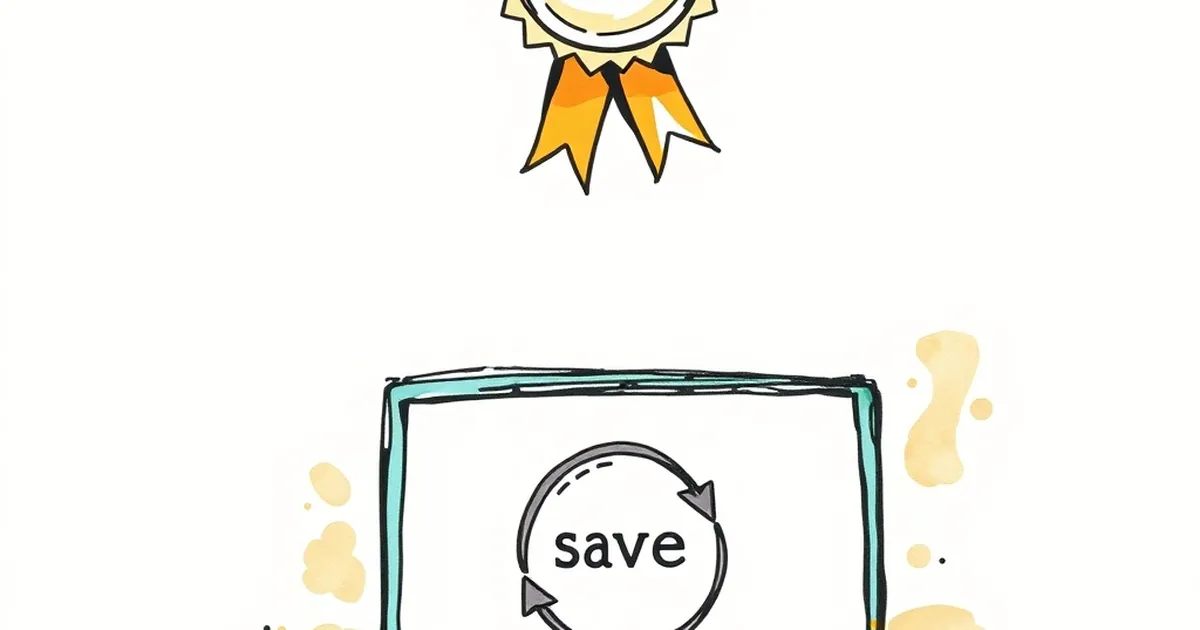
We've all watched it: you hit save, the spinner starts, and somewhere in that half-second gap a green checkmark badge pops in with a little bounce. The icon keeps spinning for another beat or two, then settles. Nothing's wrong — the file saved — but the sequence is backwards. The confirmation arrived before the thing it was confirming. So why does that tiny out-of-order moment feel so good, and what does it teach us about designing feedback for business sites?
The spinner is honest; the badge is a promise
A loading spinner is one of the few UI elements that tells the truth. It says: work is happening, duration unknown. That's an accurate description of a network request. The badge, by contrast, is a claim about the future — this worked — issued while the evidence is still in transit.
Most teams don't plan this. It happens because two systems fire independently: the frontend optimistically renders a success state the moment the request leaves, and the backend's response lands a few hundred milliseconds later. The overlap is just latency made visible. But the user experiences it as a small, pleasant surprise — the reward shows up early.
Variable timing is the whole trick
Behavioral psychology has a name for why unpredictable rewards grab us: variable-ratio reinforcement. B.F. Skinner's work on operant conditioning showed that rewards delivered on an unpredictable schedule produce more persistent behavior than rewards delivered on a fixed one. The classic illustration is the pigeon that keeps pecking because it can't predict which peck pays off.
Your save badge isn't a slot machine, and I'm not going to pretend it is. But the timing variance matters. Sometimes the badge appears instantly; sometimes it waits for the server; occasionally it's a hair late. That inconsistency is exactly what makes it register. A perfectly synchronized confirmation becomes wallpaper within a week. A slightly early one stays noticeable.
Loss aversion explains why we don't fix it
Here's the uncomfortable part: designers often know the badge fires early and leave it alone. Why? Because tightening the sequence would mean the confirmation sometimes arrives after the spinner stops — and any delay reads as failure. Daniel Kahneman and Amos Tversky's work on loss aversion found that losses loom roughly twice as large as equivalent gains. A badge that's 200ms late feels like a bug; a badge that's 200ms early feels like a bonus. The asymmetry pushes teams toward optimism, every time.
There's a real cost, though. When confirmation precedes completion, you've taught users that the badge is decorative. The first time a save silently fails after a green checkmark, trust takes a hit that's hard to win back.
What to do about it
The fix isn't to make every confirmation wait for the server — that would feel sluggish and punish fast connections. The better move is to make the states legible rather than optimistic:
- Separate the two claims. Let the spinner mean "in flight" and the badge mean "confirmed." If you want an instant acknowledgment, use a neutral state — a subtle pulse, a "saving…" label — not the success badge.
- Reserve the bounce for real confirmation. Save the celebratory motion for the moment the server actually responds. It'll feel earned, and it'll stay meaningful.
- Test the failure path first. Simulate a dropped connection and watch what the interface told the user. If the badge already fired, you have your answer.
Forward-looking teams are already treating micro-feedback as a trust contract rather than decoration. The next time you see a badge pop two seconds early, don't just enjoy it — open the network tab. The gap between what your interface claims and what it knows is where users decide whether to believe you.
— creative mess