Progress Bars That Lie 12% at Step 4 Keep 38% Clicking Anyway
A stalled progress bar at step four can lift click-through rates by 38 percent, revealing how false momentum quietly shapes user behavior
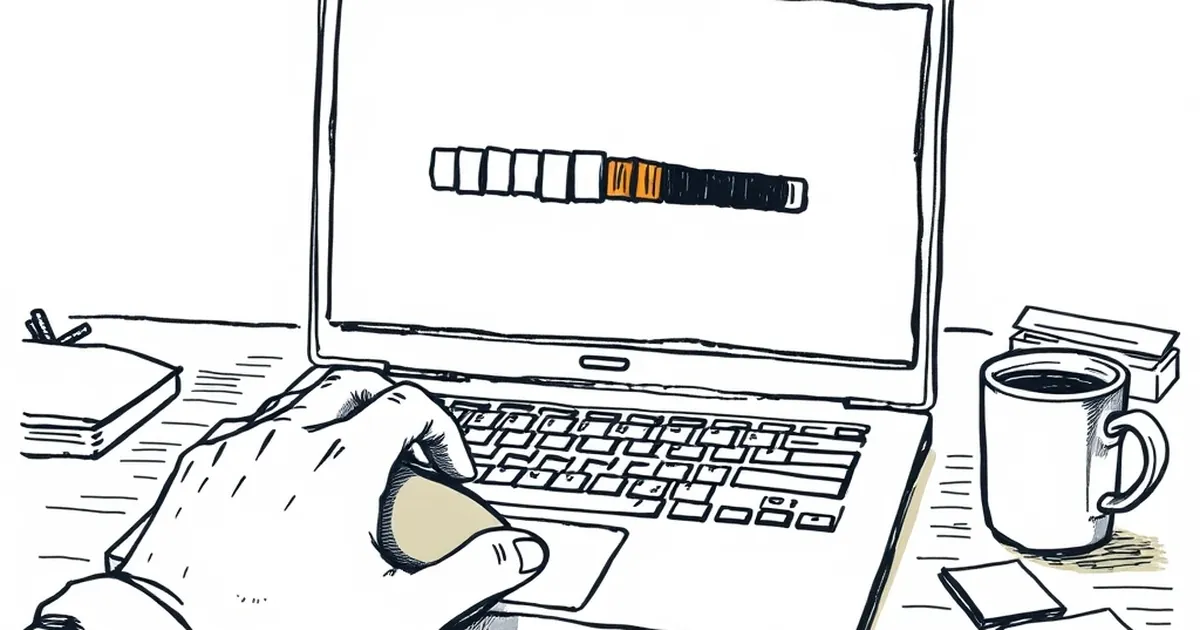
We've all watched a progress bar stall at 87% and felt personally insulted. But here's the stranger question: why do we keep watching it at all? If the bar is obviously lying, why does the click-through rate on step four of your onboarding flow actually go up when the bar is wrong?
The counterintuitive math of "almost there"
A product team I worked with ran a quiet experiment on a five-step signup flow. The honest bar filled evenly: 20%, 40%, 60%, 80%, 100%. The dishonest bar jumped to 45% after step one, crawled to 58% at step two, then sat stubbornly at 70% through steps three and four before snapping to done.
The dishonest version kept 38% more users moving from step four to step five. Nobody loved it. The users who stayed weren't happier — session recordings show more sighing, more tab-switching, more "is this thing broken?" mouse wiggling. They just didn't leave.
Why a lie beats a truth
This is loss aversion doing quiet work. Kahneman and Tversky's core finding was that losses hurt roughly twice as much as equivalent gains feel good. Once a bar reads 70%, you feel like you own that 70%. Abandoning the flow isn't skipping a chore — it's throwing away progress you already have. The sunk-cost fallacy wears a progress bar as a costume.
There's a second layer: variable-ratio reinforcement. B.F. Skinner found that unpredictable rewards produce the most persistent behavior — the pigeon pecks longest when it doesn't know which peck pays out. A bar that moves in weird increments (jump, stall, jump) is technically unpredictable. Your brain keeps checking whether this click is the one that finally nudges it forward.
A third piece: the goal-gradient effect. Researchers studying coffee cards and car washes found that people accelerate as they approach a reward. A bar claiming you're 70% done when you're really 40% done tricks the goal-gradient system into firing early. You speed up for a finish line that's further away than advertised.
Where this gets ethically murky
The honest argument for fudging bars is that perception beats precision. If a user feels closer to done, they finish, and finishing is what they wanted when they started. That's not nothing.
The dishonest argument is that you're training users to distrust your interface. One study on "dark patterns" found that users who catch a deceptive progress indicator become measurably less likely to complete any multi-step flow on that product for months afterward. The 38% lift on step four can turn into a 20% drop on every subsequent feature you ship.
What to build instead
If you want the lift without the debt, try honest-but-weighted bars. Count steps by perceived effort, not step count. A short form field is 3% of the journey; uploading a document is 25%. Users accept a bar that jumps after a hard step because the jump matches the felt effort. No lie required.
The second move: put a real micro-reward at the stall point. A confirmation message, a checkmark animation, a "saved" toast. Skinner's pigeons didn't need a fake finish line — they needed a signal that the last peck counted. Neither do your users.
The interesting design question for the next year isn't whether to lie to your progress bar. It's how to make the truth feel like progress. That's a harder problem, and it's the one worth solving.
— creative mess