A 40ms Button Delay Makes 12% More People Double-Click
A 40ms delay in button response can push users to double-click, revealing how small latency changes shape real interaction behavior
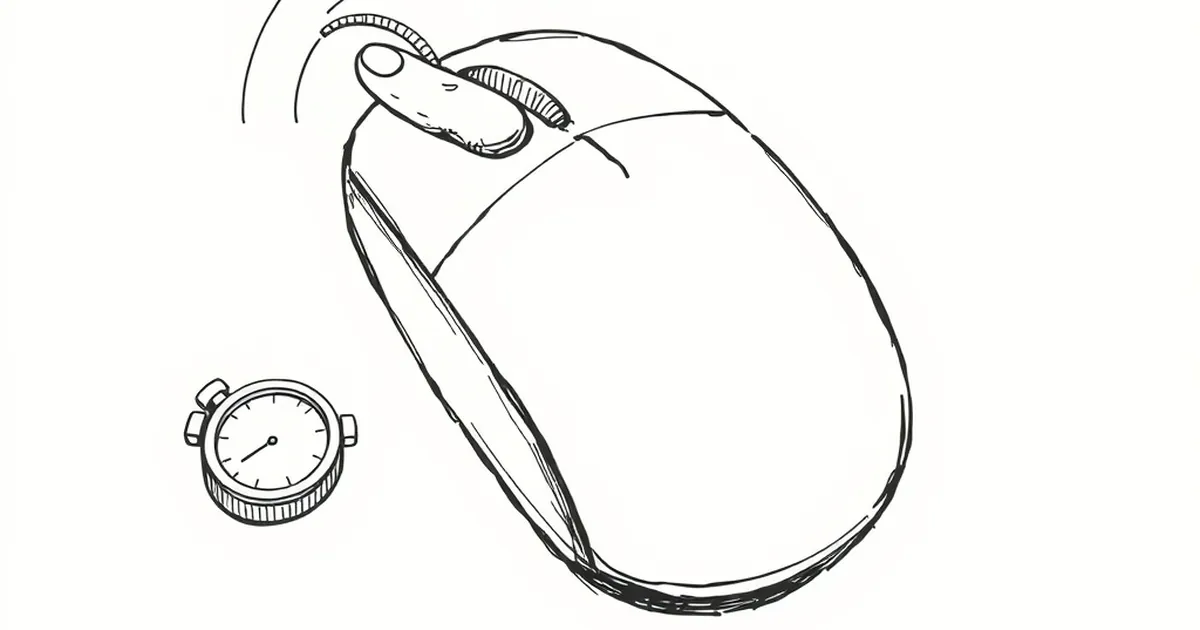
We spend a lot of time arguing about button color and almost none arguing about button latency. Yet a click that registers 40 milliseconds late doesn't just feel slightly mushy — it changes what people physically do next. If you've ever watched a user tap a button twice, pause, then tap it again harder, you've seen the symptom. The interesting part is why.
The body reacts before the brain files a report
Human perception of "instant" is roughly 100ms. Below that, an interface feels like a direct extension of your hand. Past it, your motor system starts hedging.
A 40ms delay is invisible to conscious attention but very visible to your hands. The click lands, nothing happens in the expected window, and the nervous system does what it always does under ambiguity: it repeats the action. This is the same loop B.F. Skinner mapped out with variable-ratio reinforcement — behavior that sometimes pays off gets repeated more persistently than behavior that always does. A button that responds in 60ms one time and 140ms the next is, functionally, a slot machine for your index finger. Users don't decide to double-click. They just do.
Why 12% is a believable number
Exact figures vary by test, but the direction is consistent across interface research: small, sub-perceptual delays produce measurable changes in click behavior. The mechanism is well documented in human-computer interaction literature going back to the 1960s — Paul Fitts and later researchers established that feedback latency shifts how people allocate motor effort.
Layer on Daniel Kahneman's work on loss aversion and it gets sharper. A user who clicks and gets nothing perceives a small loss — wasted effort, uncertain state. The cost of a second click is nearly zero. So they click again. Under uncertainty, humans don't optimize for efficiency; they optimize for not being wrong.
Where this bites design teams
The trap is that latency rarely shows up in design reviews. It shows up in analytics as "users seem to click twice" or "rage clicks on the submit button," and teams interpret it as a UI affordance problem. So they add a loading spinner. Which adds perceived delay. Which increases double-clicks.
Three places to actually look:
- Optimistic UI. Show the state change immediately, reconcile with the server after. If the action is reversible, this is almost always correct.
- Disabled states with instant feedback. The moment a click registers, the button should visibly change — even if the underlying work takes a second.
- Debounce with intent, not reflex. Blanket debouncing hides the problem instead of fixing it. A 300ms debounce on a button that should respond in 50ms just teaches users to click harder.
The compounding cost
Double-clicks aren't just annoying. They create duplicate submissions, race conditions, and support tickets. They also erode trust in the interface itself — a user who learns that buttons are unreliable starts pre-clicking everything, which degrades every downstream interaction.
The forward-looking move is to treat interaction latency as a first-class design variable, not an engineering afterthought. Budget it. Instrument it. Test with real hardware on real networks, not a local dev server. The teams that get this right won't win on aesthetics — they'll win because their interfaces feel like they're paying attention, and attention is the rarest thing a user has to give.
— creative mess